
PoraShore — Travel Booking Platform
A tour-booking platform engineered for Bangladeshi travel reality: packages with live seat counts, a 30% bKash advance that kills ghost bookings, itineraries written like humans read them, and an operator back-office where manifests, partner settlements and weather cancellations are normal rows, not WhatsApp panic. Flagship blueprint: our own travel desk's engine, deployable for agencies — and the shared backbone for this studio's travel brand.
The product itself, on every device
studio renders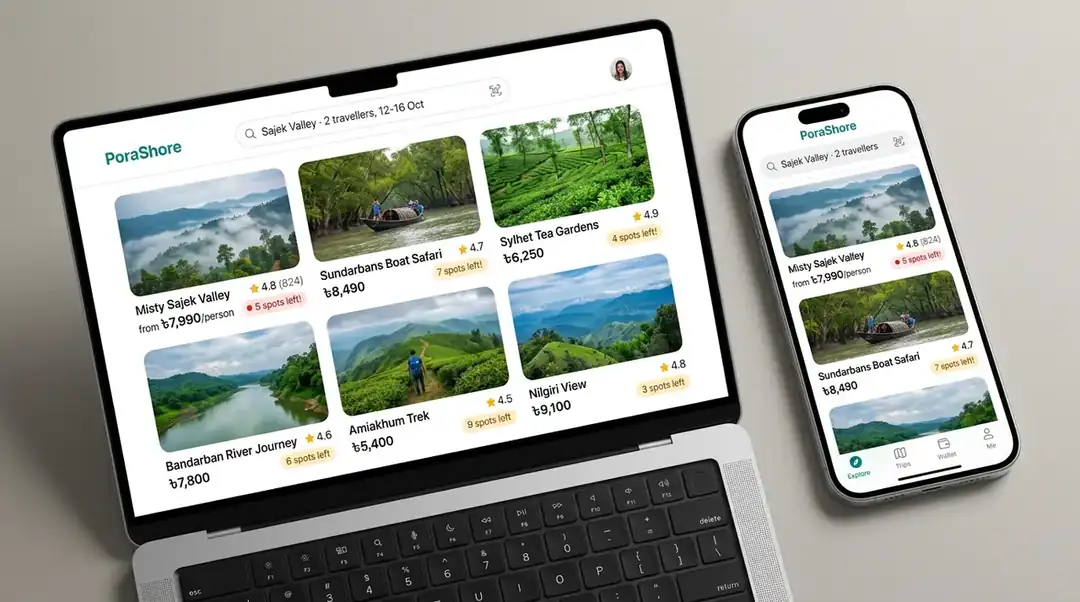
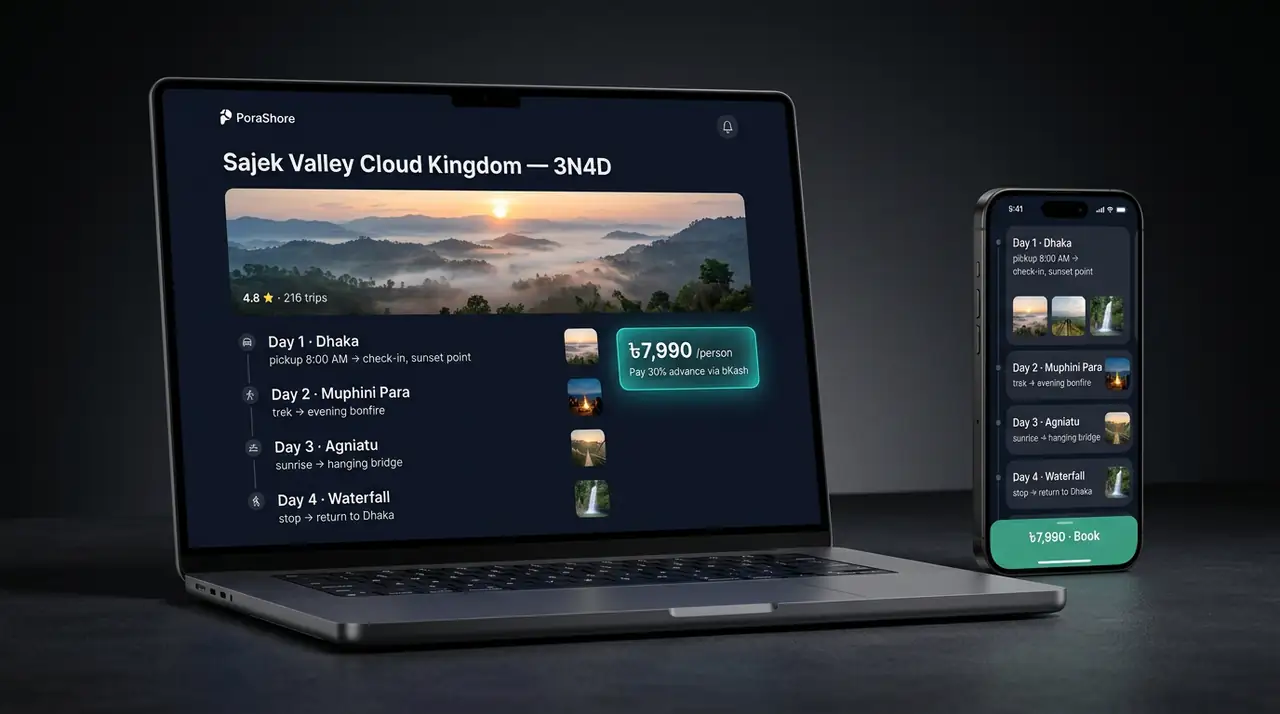
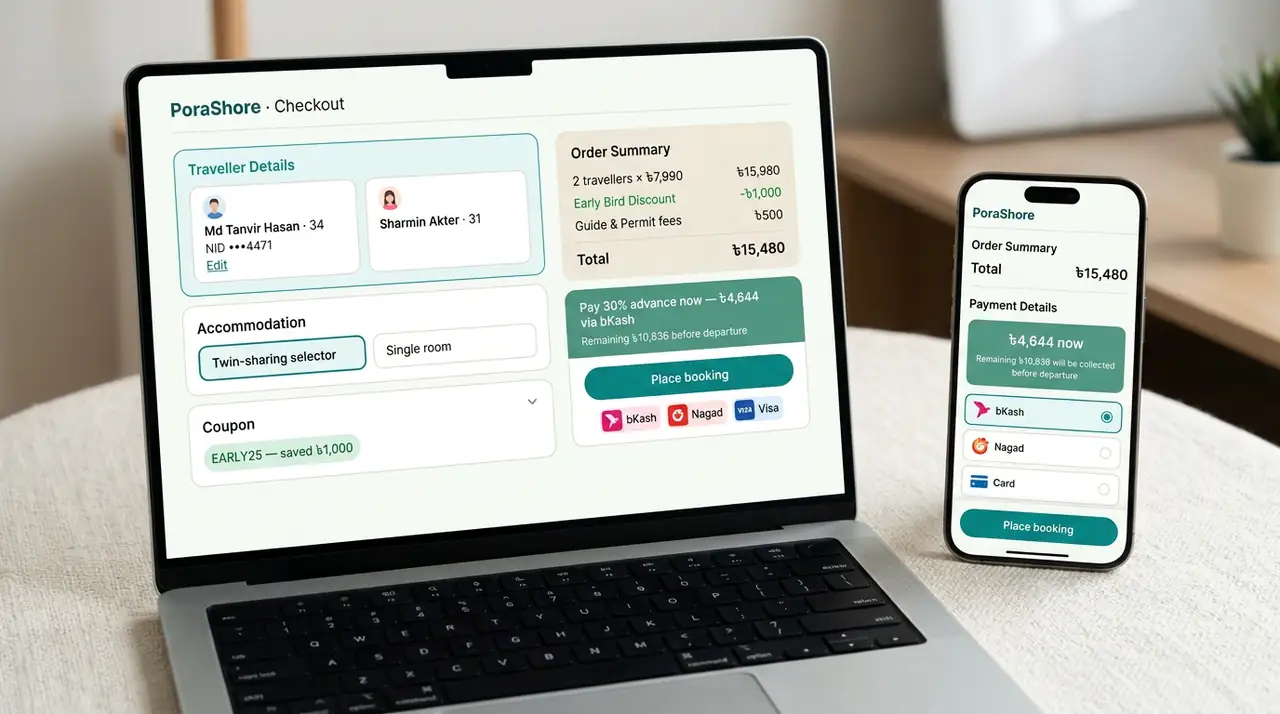
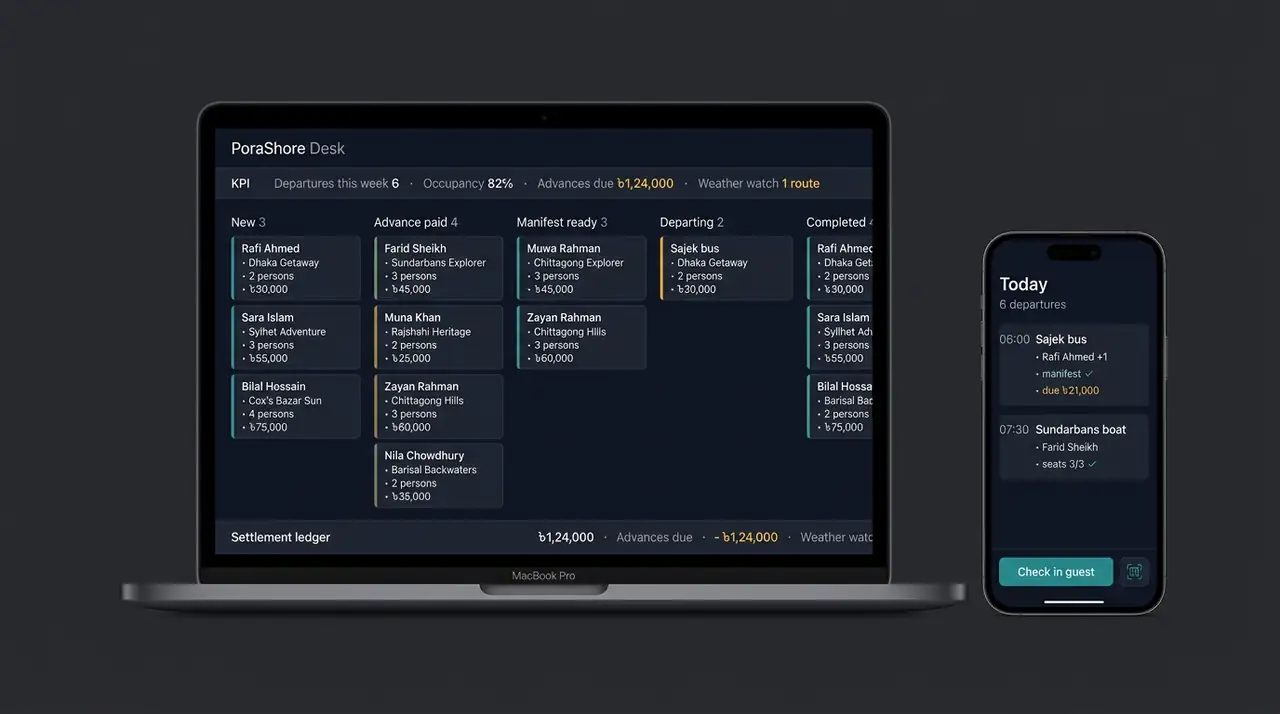
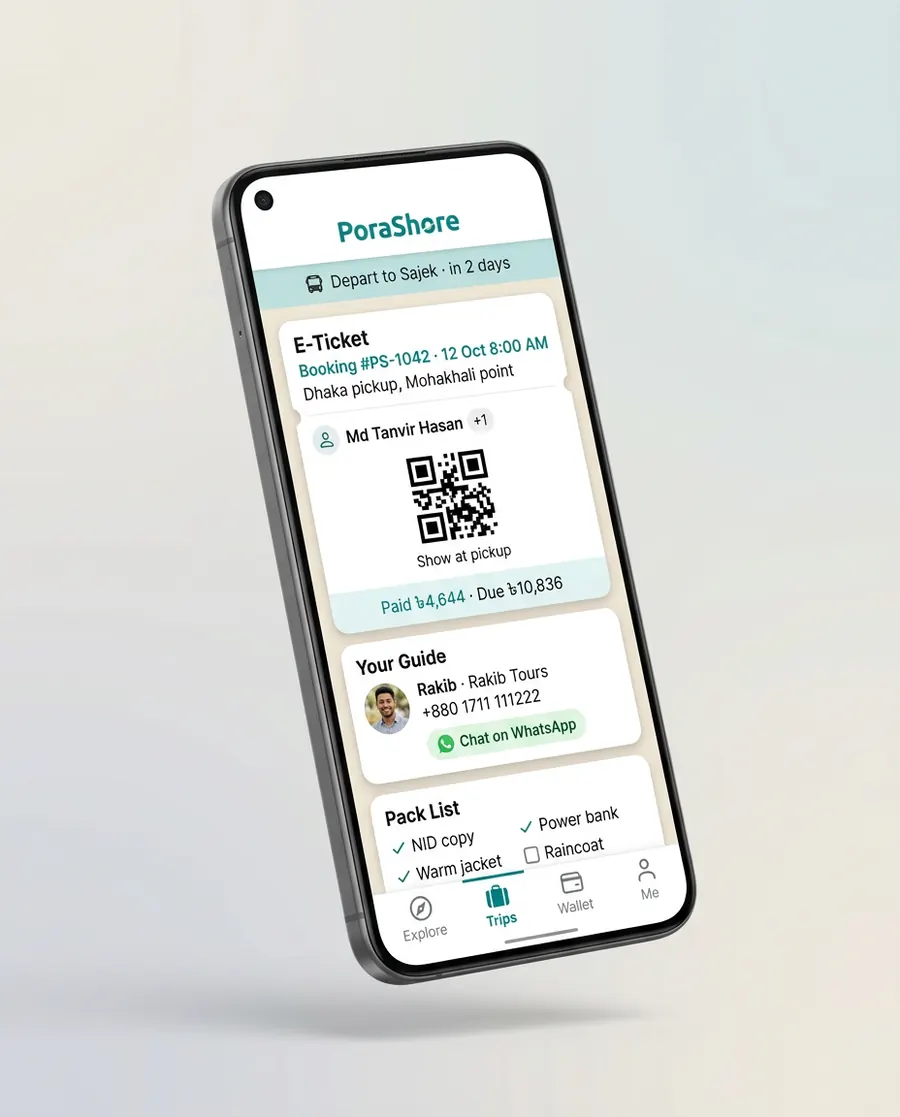
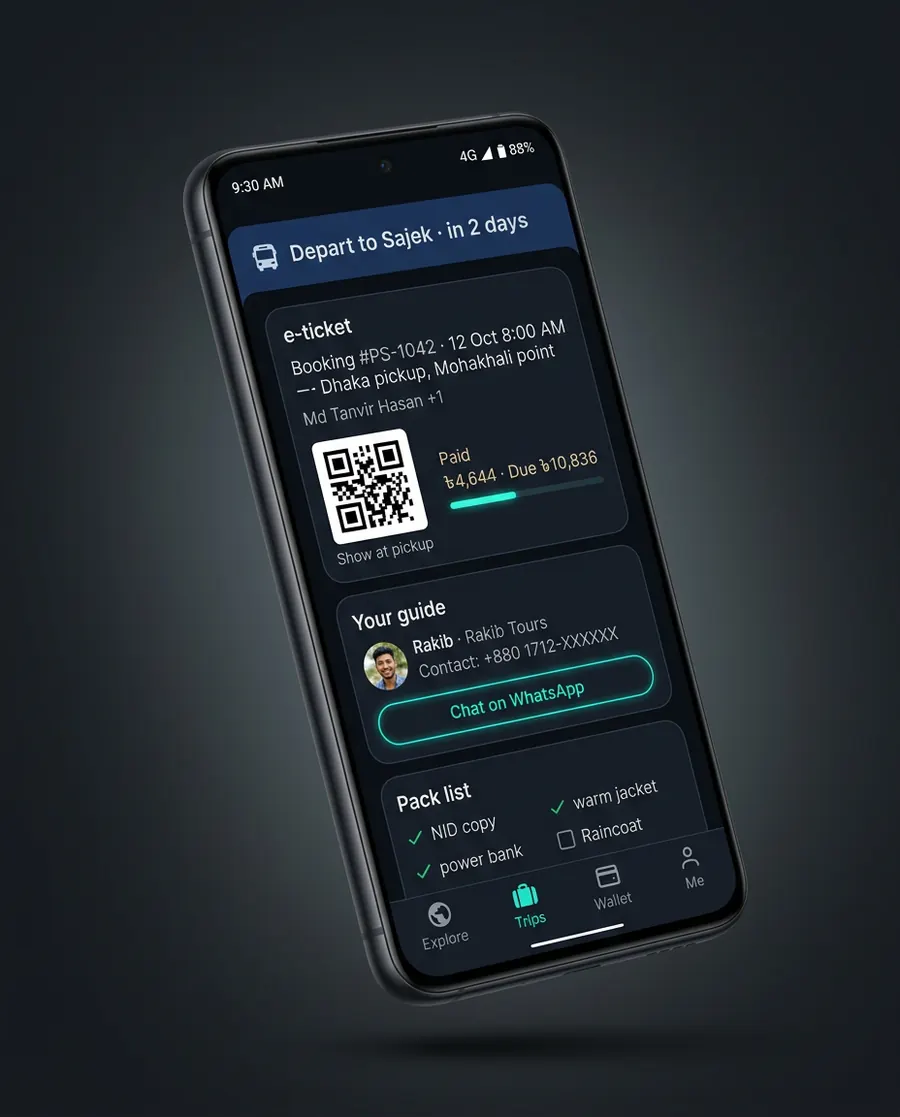
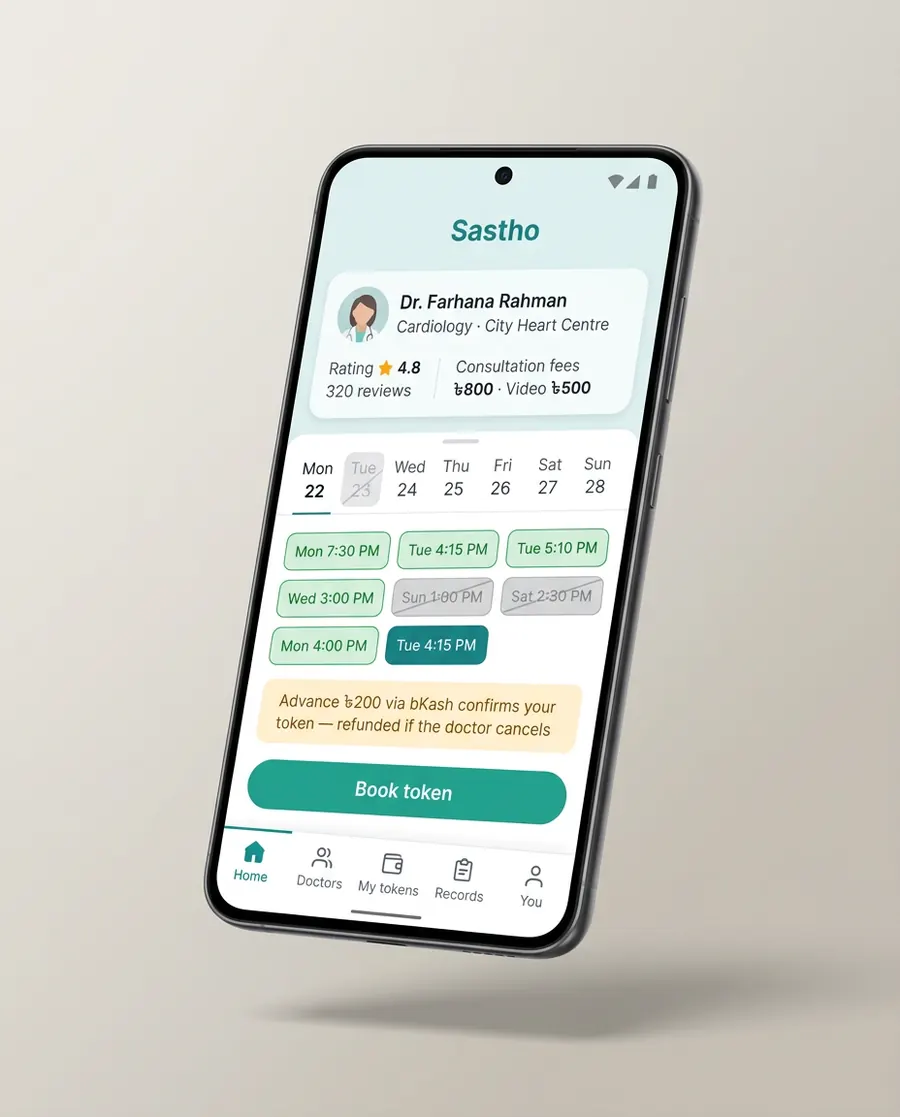
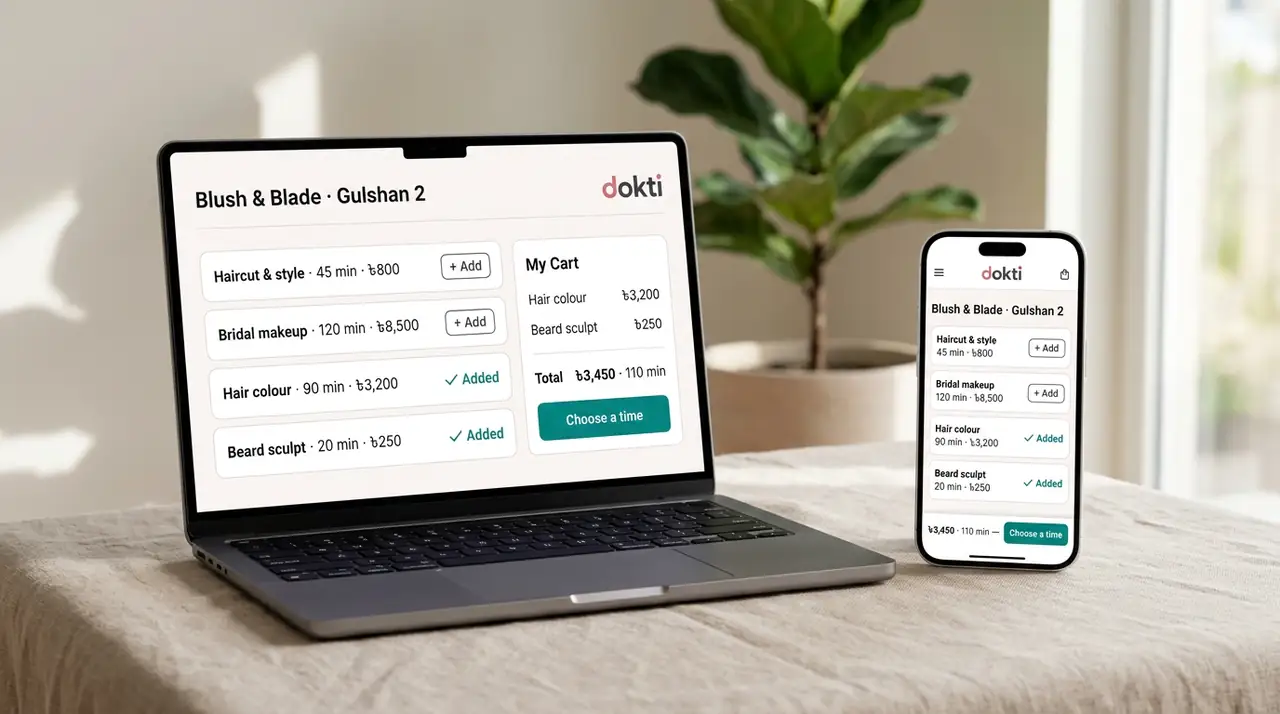
Frames of the live product rendered in the studio pipeline — the site itself is the demo: open anything, it is this codebase running.
The build
Online travel in Bangladesh runs on three fragile things: the Facebook comment that turns into a booking nobody confirms, the advance that arrives after the seat is gone, and the partner settlement nobody can reconcile in the off-season. PoraShore is the platform those three built us — tour packages as real inventory (seats, dates, capacity), an advance-first checkout that only accepts a booking when money is in the rail, a traveller app that carries the pickup QR and guide contact for the 2 a.m. bus, and an operator console where manifests, cancellations and partner ledgers are just rows. It is the engine behind this studio's own travel-desk experiments, and it is offered to agencies the same way: your brand, your partners' money, our boring dependable plumbing.
What we handled
- Packages as inventory: per-departure seat counts, sold-out states, capacity per transport and room type
- Advance-first checkout: 30% via bKash/Nagad locks the seat; auto-refund when the agency cancels, ever
- Itinerary editor operators actually use: day rows, meal flags, inclusions that render identically on card and PDF voucher
- Manifest printing per departure with guide confirmations and hotel voucher status on one checklist
- Partner settlement ledger: expected-versus-received per departure, mismatches tinted, exports for the accountant
- Weather-hold and free-cancellation windows as first-class policy states — the monsoon is a feature, not an apology
The seventh flagship blueprint, and the one closest to home: PoraShore is the booking and operations platform this studio built for the way Bangladeshi travel actually transacts — packages sold as live inventory, advances through bKash that make ghost bookings expensive, itineraries that read like a human wrote them, and an operator desk where manifests, weather holds and partner settlements are ordinary rows. It exists because our own travel-desk experiments needed it; agencies get the same engine wearing their brand, and the studio's travel presence will run on this exact stack the day it goes public.
Travel here is booked in comments, and cancelled in silence
The country's tour business runs on a page, a post, and a phone number: someone comments “ki khabo?” on an Eid package, an inbox fills with fifty enquiries, sixteen become “confirm”s over WhatsApp, six actually show up to pay the advance, and the agency buys bus seats for all sixteen while absorbing ten cancellations as the cost of doing lovely, chaotic business. Nothing about that is a people problem; it is a missing-instrument problem — nobody ever built the software layer where a booking is money-in-the-rail and a seat is counted, not vibes.
PoraShore starts from that floor. A package is a set of departures with real capacity per transport, room type and guide; an enquiry is not a booking until the 30% advance lands through bKash or Nagad; a cancellation inside the policy window refunds itself without a single awkward conversation. The rest of the product — the traveller app, the manifest printer, the settlement ledger — exists to make the week that follows the booking as boring as the checkout was rigorous.
The checkout is the business model
Advance-first is the whole trick: the seat inventory only decrements when payment intent converts, and the split — ৳4,644 now against ৳10,836 before departure — is stated on the card with the same arithmetic the ledger will use later. Coupons carry their savings into every downstream view, traveller NIDs attach to the manifest line, and the free-cancellation window renders as a countdown, not fine print. Agencies we shadowed asked for one more “simple booking form” feature we refused to build: a booking without money is exactly the liability they pay for every season.
The checkout ships in two themes — light and dark, designed together, not filtered — because this country books trips at midnight from bed more often than at a desk at noon. The same state machine backs both, so a booking that starts on a phone at 1 a.m. finishes identically on the office laptop at nine.
The trip lives on the traveller's phone
After confirmation the app takes over the work the WhatsApp thread used to do badly: a pickup QR with the point and time that the bus assistant can scan in daylight or at 2 a.m., the money line (paid, due, refunded) visible to both sides, the guide's number one tap from a WhatsApp chat, and a pack list that actually reduces on-trip support calls — because half of package support is somebody's forgotten raincoat. Itinerary day-rows render from the same source as the voucher PDF, so what the page promised is structurally what the traveller holds.
It is a PWA by principle: installable, offline-readable for tickets, and free of store review delays when a season's policy changes mid-week. The traveller surface must never be the reason an agency cannot update a pickup point at dawn.
The operator desk: manifests, settlements, monsoons
The kanban is the agency's real day — New, Advance paid, Manifest ready, Departing, Completed — with per-departure checklists where guide confirmations and hotel voucher sends are gates, not hopes. The manifest printer produces the document the bus assistant actually collects on: names, NIDs, room splits, due balances. Every partner who carries a slice of the package — hotel, transport, boat — gets a settlement view showing expected against received per departure, mismatches tinted amber, exports ready for the accountant's Monday.
Weather is modelled, not excused: routes carry a watch state, and a forecast trigger converts held departures into policy-defined options — reschedule with seat priority, refund without argument, partial credit — all of it recorded as normal rows in the same ledger. Monsoon cancellations stop being a crisis when the software has always treated them as a state.
Our own travel brand rides this stack
This blueprint is unusual here in one honest way: it is not only a product we would deploy for agencies, it is infrastructure our own travel operations are being built on — the public brand and its domain land on this engine, and when this page links to it, that link will be a first-party deployment, not a testimonial. Until that day, the copy says what is true: the platform runs internal operations, the agency pilot is the offer, and nobody is quoting growth numbers that do not exist yet.
For agencies the deal mirrors every blueprint here: your brand, your merchant accounts, your partner agreements; our licence is flat and your data exports in documented formats. Travel platforms that take commission on your own tours are selling you a cage with a nice view — we would rather be the plumbing you never resent.
Public record
- Blueprint status
- In-house flagship — built and run on this studio's own travel-desk operations; agency deployments are the offer, first partner priced like a pilot
- Surfaces
- Traveller web + PWA (light & dark) · operator console · manifest printing · settlement ledger
- Booking discipline
- 30% bKash/Nagad advance, auto-refund on agency cancel, weather-hold policies as real states
- Deploy shape
- Agency-branded store in 4–8 weeks; hotel, bus and boat partners get their own settlement views
Under the hood — what each box took to build
Craft, per feature
Departures as real inventory
Capacity per transport, room type and guide bound to each departure date; sold-out and weather-hold states propagate to search, card, checkout and app simultaneously — one truth, four surfaces.
Advance-first money math
30% bKash/Nagad intent gates the seat, the due-before-departure line is the same arithmetic in the ledger and the traveller app, and policy-window refunds run themselves, logged per rail with gateway timestamps.
Vouchers from the itinerary source
Day rows, meals and inclusions authored once render identically on the shop card, the traveller timeline, the printed manifest and the PDF voucher — the promise and the paperwork are the same object.
The 2 a.m. traveller PWA
Installable web app with offline ticket cache, scannable pickup QR tuned for night contrast, guide WhatsApp one-tap and pack lists that cut on-trip support load — store-free updates when the season turns.
Manifest & gate checklists
Per-departure operations: guide confirmed, vouchers sent, seats allocated — printing what the assistant collects, blocking “Departing” until the gates close, with the day's due balances on the same sheet.
Partner settlement ledger
Expected-against-received per departure per partner, amber mismatches, weather-policy adjustments recorded as rows — the reconciliation that agencies do in a notebook today and lose in a drawer tomorrow.
Commissioning this shape of product
The plan, as we would propose it
Season anatomyWk 1–2
Load one real package end to end: departures, capacity math, partner rates, cancellation and weather policies. The agency's last-season ghost-booking count sets the pilot success bar — measured, not promised.
Storefront & advance railWk 2–4
Public cards with live spots, advance-first checkout on the agency's own bKash/Nagad accounts, and the traveller PWA with pickup QR — soft-launched to a single real departure group.
Ops & settlementWk 4–6
Operator kanban, manifest printing and the partner ledger wired to two live departures; every money movement reconciles before the desk is allowed to go paperless.
Cutover & seasonsWk 6–8
All open bookings imported, WhatsApp threads retired to emergency channel, weather-hold drills run against a real forecast, and the exports fire-drilled with the accountant before the next season sells a seat.
What a client actually wins
Ghost bookings become a number that goes down
Advance-gated inventory converts “confirm” from a word into ৳4,644 — the agency stops buying seats for people who never intended to board, and the season's cancellation math is tracked instead of felt.
Departure day runs on a checklist, not a shout
Manifests print with the gates already green — guide confirmed, vouchers sent, balances shown — and the assistant scans QRs instead of arguing over names, which is the difference a traveller actually feels.
Partner money stops being oral history
Expected against received per departure per hotel and bus, with mismatches tinted the week they happen — settlement season stops being archaeology and the agency's margin stops leaking quietly through it.
Monsoons hit states, not reputations
Weather-hold is modelled policy — reschedule priority, refund windows, credit terms — so the cancellation a traveller remembers is the software treating them fairly, not the agency improvising under pressure at ten at night.
What is not true (yet)
- Blueprint truth with one twist: this runs our internal travel-desk operations and the studio's own public travel brand is planned on it — there are no agency case studies yet, and the pilot is priced like it: we build our reputation one real season at a time.
- Ground reality is not in scope as a service: PoraShore sells and operates the booking, not the tour — the agency still runs buses, still handles the hotel that lost a bag, and the software is honest about where its responsibility ends.
- No flight inventory, no foreign OTA feeds: packages, ground transport and boats are this platform's native world; agencies needing airline GDS integration need a different, more expensive machine and we say so in week one.
- Payment-rail time is borrowed reality: bKash/Nagad refunds move on their windows, not the agency's mood, so the policy engine promises initiation and ledger truth, never “instant money in your account” language the rails cannot honour.
Testimonial slot — reserved, not invented
The listing has no review wall to quote yet — so there is no quote here. Real, credited words move into this card as players leave them.
Sponsored placement — reserved, disclosure first
Placements & partners
This is where a genuinely used tool or partner link would live — hosting, device labs, our travel products. It ships empty and labelled on purpose: when a sponsored link arrives, it arrives wearing this disclosure, never dressed up as editorial.
Answers where they belong
Questions this project answers
Want PoraShore-class engineering for your idea?
One brief in, the composer arrives with your platforms pre-ticked — Android, iOS, web, admin.
Is this your travel company's website?
It is the platform our travel operations are being built on — when the brand goes public this page will link to it as a first-party deployment. Today the honest statement is: internal operations run it, agencies can pilot it, and no public consumer site has launched from it yet.
Why does a booking require an advance at all?
Because in this market a booking without money is a placeholder for somebody who could otherwise have bought the seat — the 30% rail-gated advance is the mechanism that turns the agency's cancellation tax into a tracked, refundable, policy-governed number, and every feature downstream depends on that truth.
Can our existing enquiry flow (WhatsApp, phone) survive this?
It becomes a channel instead of the ledger: the desk takes the phone call, adds the traveller, and sends the same advance link the storefront would have — the money gate is non-negotiable, the front door for the customer is flexible, and nobody is forced to abandon how Dhaka actually books.
What do our hotel and transport partners see?
Their own settlement view: expected against received per departure, manifest rows for their seats, and the mismatch list — no access to the agency's margins or the traveller's other bookings. Partners reconcile with data instead of phone calls, which is the fastest way to make them prioritise your group next season.
How does a monsoon actually behave in the system?
Routes carry weather-watch states from the forecast policy the agency sets; a triggered hold opens the policy's options — reschedule with seat priority, refund in the same rail, or credit — each decision recorded as a ledger row the traveller and the agency can both read after the fact.
What does this cost an agency?
A flat licence per agency plus the four-to-eight-week deployment — never a percentage of a booking, because commission-taking platforms have a structural interest in your volume that is not your interest in your margin. The export contract and pilot price are in the brief before anyone signs anything.
Begin the ascent
Everything on this page is checkable.
Store listing, code craft, and the way we scope — click through and verify, then send us the brief.