
ShikkhaOS — School Management System
A school ERP shaped for Bangladeshi institutions: register-grade attendance that messages parents automatically, a fee lifecycle wired to bKash and Nagad, board-style mark sheets that become printed report cards, and an office dashboard that runs on any connection. Flagship blueprint: production-grade and deployable, not yet a client case.
The product itself, on every device
studio renders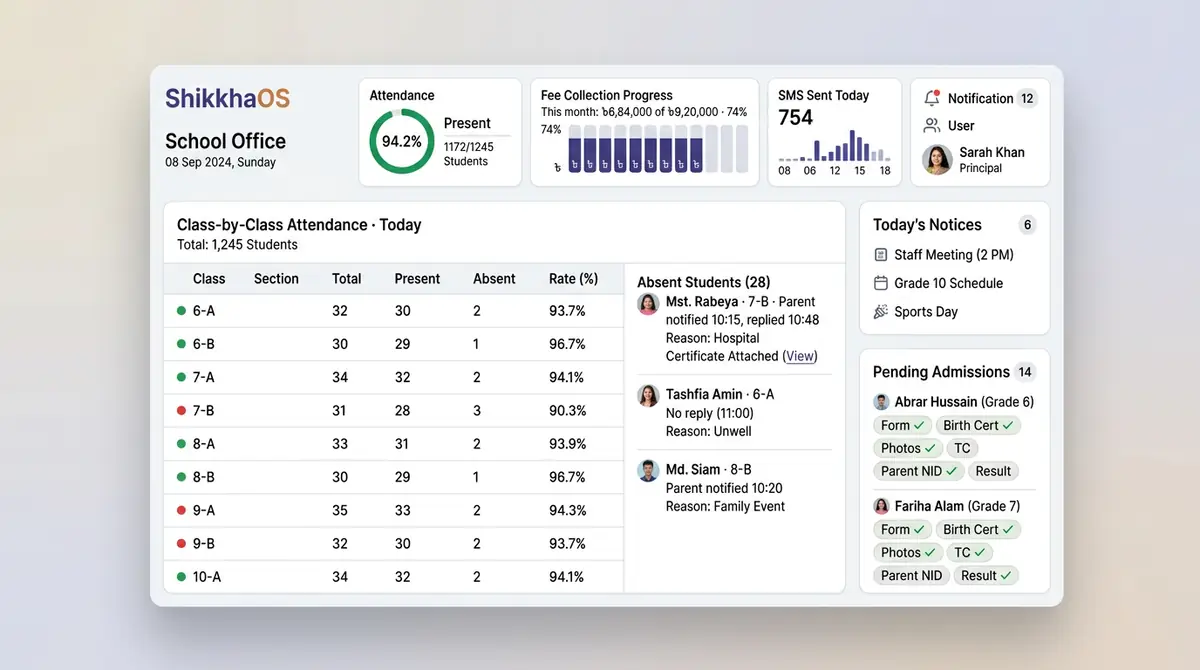
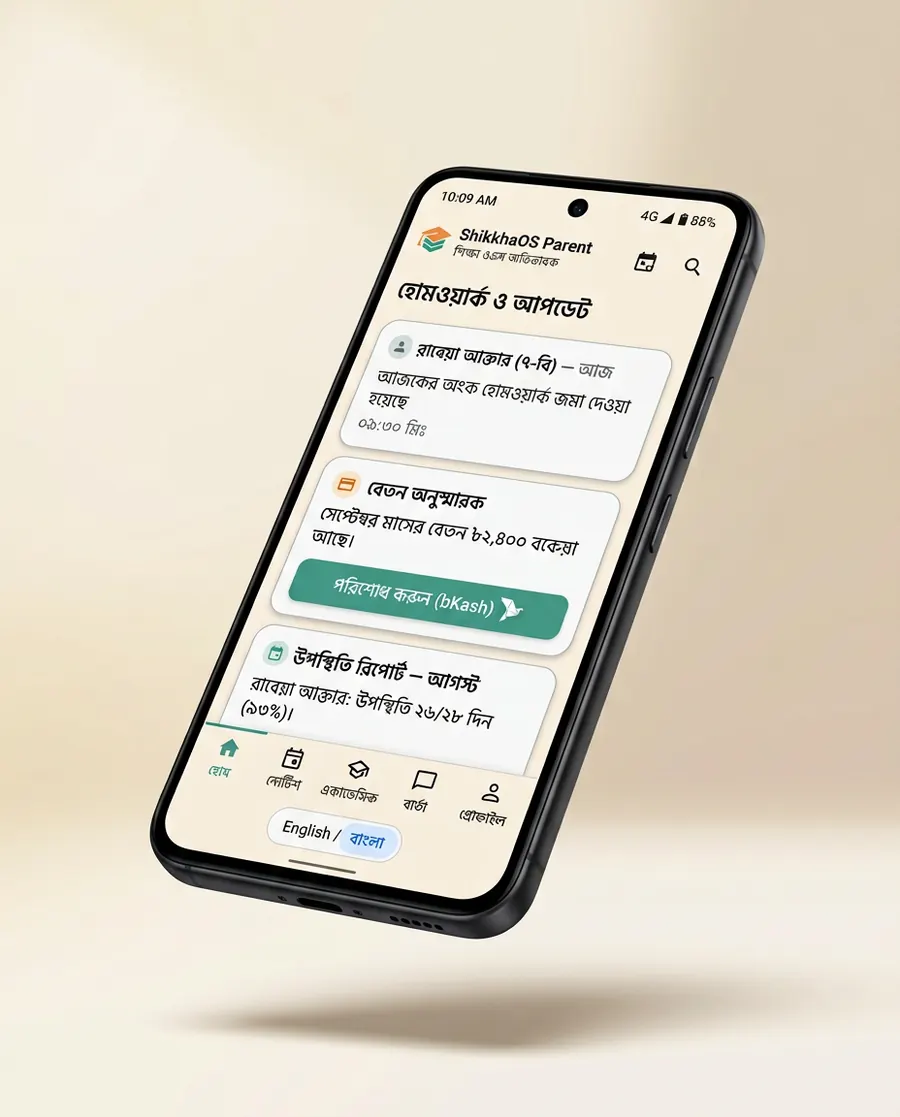
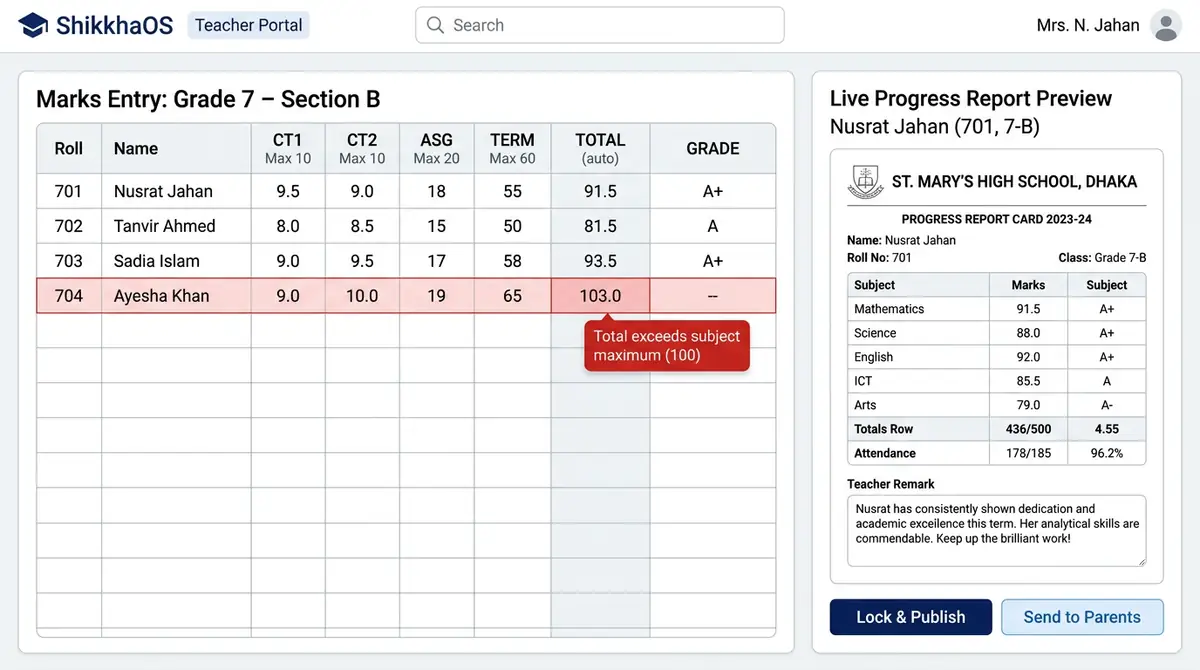
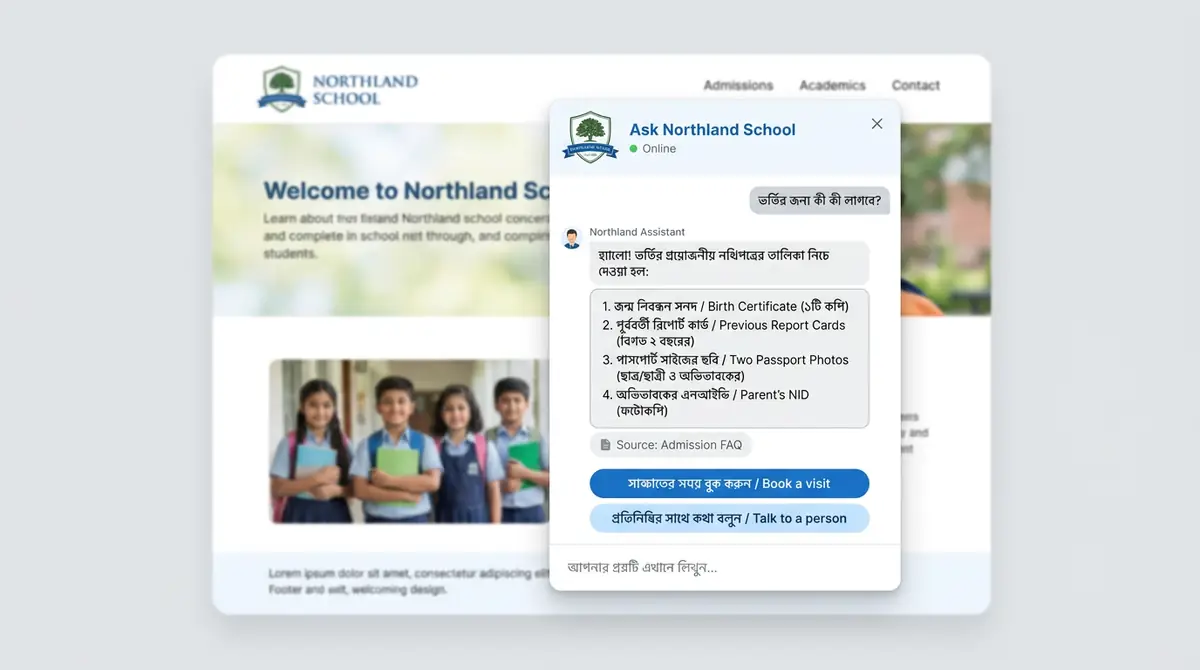
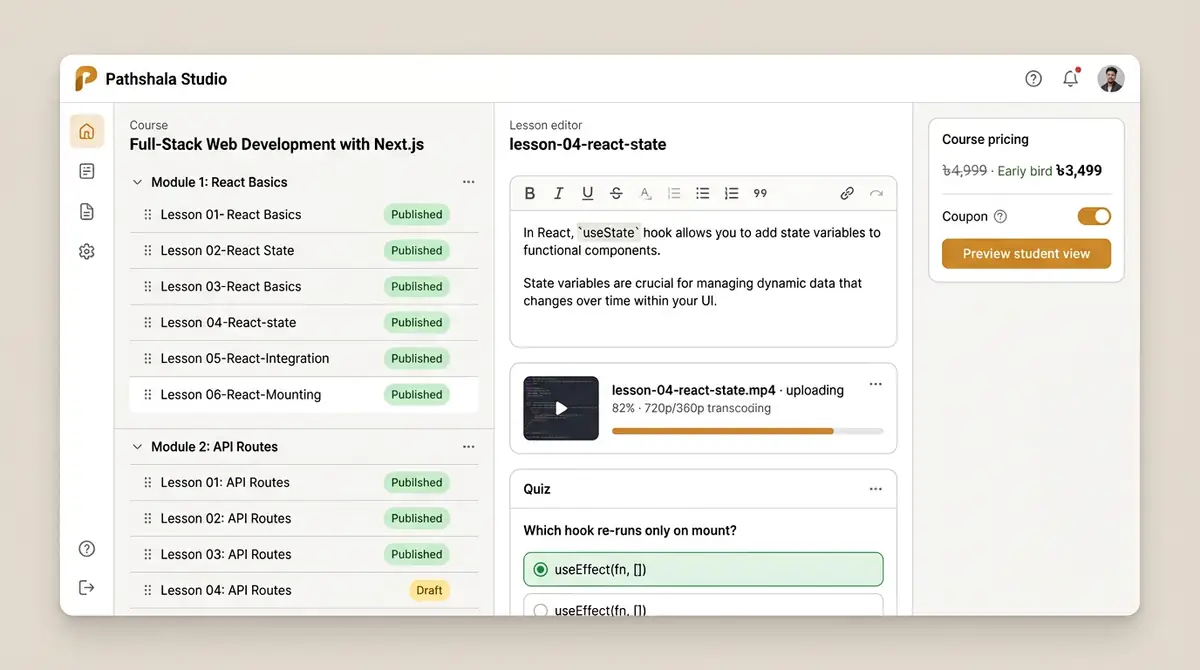
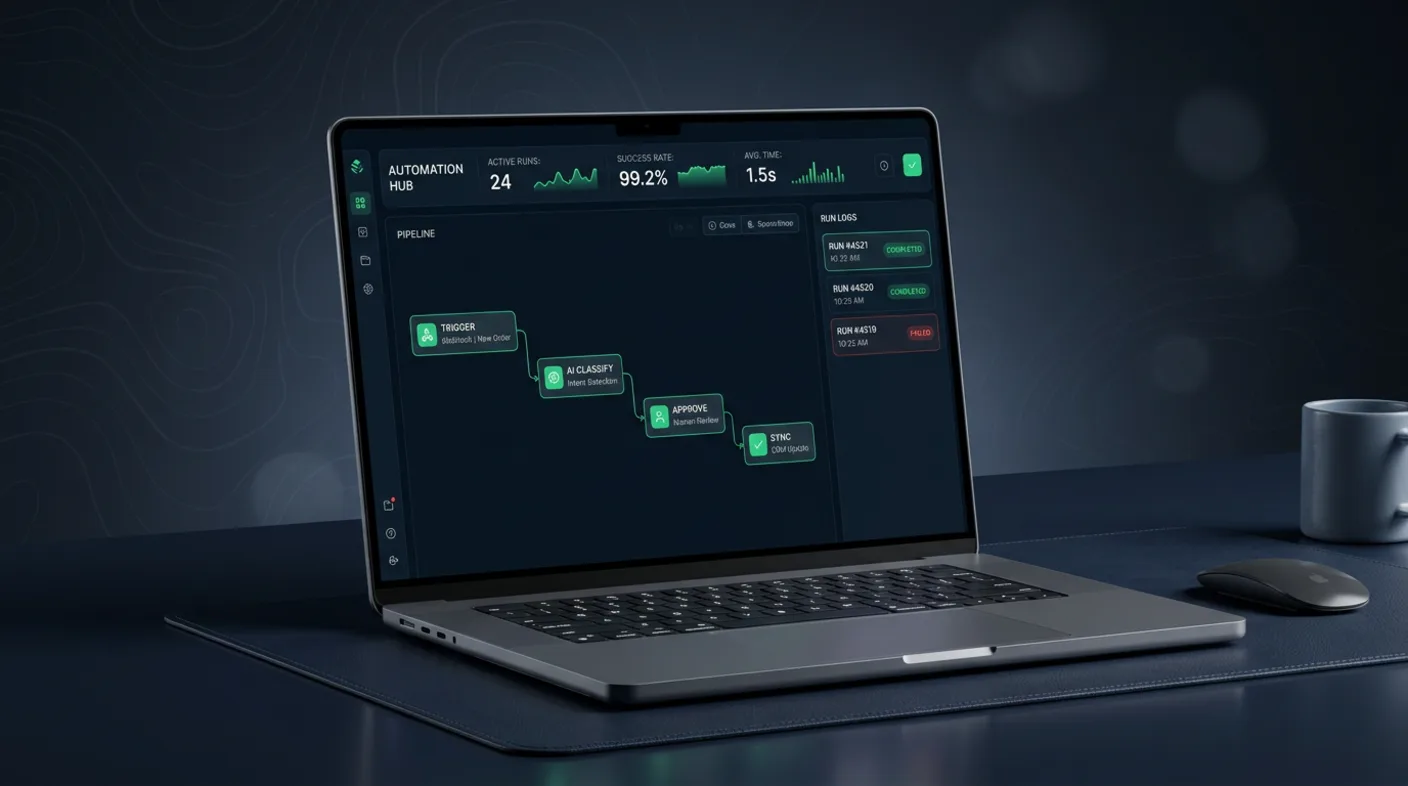
Frames of the live product rendered in the studio pipeline — the site itself is the demo: open anything, it is this codebase running.
The build
Ask any school office what runs the institution and the answer is the same: a leather register, a spreadsheet, and whoever remembers to send the SMS pack. The data is real but the intelligence is not — absentees reach parents by memory, fee dues live in a notebook, and the report-card season eats a week of every teacher. ShikkhaOS is that office rebuilt as software the office can actually use: register-fast attendance, a fee lifecycle on real payment rails, a results engine that respects board grading rules, and parent messaging that never needs a human reminder — deployed on the school's terms, with an exit door that always stays open.
What we handled
- Attendance in register speed — tab order, shortcuts, offline-tolerant — with automatic parent notifications
- Fee lifecycle: invoices, bKash/Nagad payment links, receipts, overdue reminders, month-end reconciliation
- Results engine: per-board assessment splits and GPA rules, instant flagging, auto typeset report cards
- Bangla-first parent app as an installable web app — no store approvals, works on the phone they already own
- Admissions queue with document checklists — birth certificate, TC, NID — every pending paper visible at a glance
- The school owns the data: their server or ours with full export, formats documented, no hostage formats
The third flagship blueprint, aimed at the biggest unsexy software market in the country: school offices. ShikkhaOS is a complete school ERP — attendance, fees, results, parent communication, admissions — engineered around how Bangladeshi institutions actually run: shared desktops, patchy connections, staff who live in registers, and parents who live in SMS. Built to production standard, exercised in-house, and honest about what it is: our platform, ready for a school's first term, not a case study we are pretending to have.
The register is not the problem — the memory is
Almost every school in the country already keeps perfect data somewhere: the attendance register, the fee notebook, the mark sheets in the teacher's drawer. The failure is never collection — it is between the columns. A student is absent at 10:15 and the parent learns at 6 p.m., if ever. A fee is due on the 10th and chasing is a personal favor the office does on Fridays. Results week turns four teachers into a typesetting department. None of that is a digitization problem; the records are digital-adjacent already. It is a wiring problem.
So ShikkhaOS was scoped as wiring, not replacement: keep the register's speed and the office's habits, and let the system do what memory does badly — notify, remind, reconcile, typeset, audit. Every module has to pass one test: would a head clerk with a shared desktop and no training use it on day three? Anything that needs a manual is not done.
Five modules the office opens every day
Attendance is the spine. The class teacher enters exactly the way the paper register worked — roll numbers down the column, P/A/M for present, absent, marked-late — with keyboard-first flow and offline tolerance, because half the corridors lose signal between periods. The moment a student is marked absent, the parent message queue fires automatically; the reply — “hospital, certificate coming” — attaches to the student's row, not to someone's recollection.
Fees, results, communications and admissions sit on the same student graph: one fee invoice knows every sibling in the school; one late mark sheet blocks publishing but never punishes the other subjects; the admissions queue tracks documents (birth certificate, TC, parent NID) with the same checklist discipline the reception counter already uses. The office console is role-scoped — head clerk, accounts, class teacher, principal — each seeing one screen that fits their job, not an admin panel with nine hundred buttons.
The fee lifecycle is the actual ROI
Schools do not buy software for attendance; they buy it because of the fee notebook. ShikkhaOS puts the whole money loop on rails: invoices generated per class and sibling bundle, payment links over bKash, Nagad or SSLCommerz, receipts auto-issued, and the overdue list maintained by rules the school sets — grace days, reminder cadence, who gets the call. Month-end reconciliation matches gateway settlements against the ledger and shows the two rows that do not agree, because that is exactly where cash goes missing.
Collections are where a term pilot wins the staff over: the accounts teacher who spent Friday chasing slips finds the dashboard already knows who paid. That single conversion — from notebook anxiety to a progress bar — is why we quote the fee module in every pilot and why delinquency figures are something we measure with the school's own last-year numbers instead of quoting anyone else's.
Parents get one Bangla-first surface
The parent app is an installable web app, not a store download — no iOS bill, no Play review delay, and it opens on the mid-range Android every guardian already owns. Homework submitted, attendance at 96.2%, a fee card with one bKash button: three cards, Bangla and English in the same voice. It is deliberately shallow — notifications, confirmations, payments — because deep parent portals go unread; the parent will open a message that arrives, not a login they must remember.
Tone is engineered as carefully as flow: absent-student messages state facts and next steps, never blame; reminders are polite until they are firm, on the schedule the school chooses. A Bangla-speaking editor signs off every template before deployment — support register at a school is not a translation problem, it is a respect problem.
The school's data stays the school's
Deployments run on the school's own server room machine or on ours — their choice, in writing. The database is documented Postgres with a full export story: every table, every format, an annual fire-drill export the office can run without calling us. Report cards typeset server-side to printable PDF because that one artifact has to survive the software — in ten years the paper still has to match the database.
This is also our answer to the local ERP aisle, where the real product is the lock-in. We compete by making leaving cheap and staying convenient — and we are upfront that the offline-tolerant design has costs too: sync conflicts are resolved by keeping the register as the last word, and some cross-module analytics wait for connection rather than pretending.
Public record
- Blueprint status
- In-house flagship — full stack built and internally exercised; not yet a live school deployment
- Modules
- Attendance · Fees · Results · Parent comms · Admissions · Role-based office console
- Money rails
- bKash, Nagad and SSLCommerz fee flows with receipts, reminders and reconciliation
- Deploy shape
- School-owned hosting or ours with export rights; term-pilot rollout in 6–10 weeks to core modules
Under the hood — what each box took to build
Craft, per feature
Register-speed attendance
Keyboard-first entry that mirrors the paper register, queued offline writes with the class list as last word, and automatic parent notification with reply threading onto the student record.
Fee lifecycle with real rails
Per-class invoices and sibling bundles, bKash/Nagad/SSLCommerz payment links, auto-receipts, rule-driven overdue lists, and settlement-vs-ledger reconciliation that finds the two disagreeing rows.
Board-aware results engine
Assessment splits and GPA rules encoded per board convention, out-of-range flags while typing, publishing locks per subject, and report cards typeset to printable PDF the same moment marks lock.
Bangla-first parent web app
Installable PWA with homework, attendance and one-tap fee payment cards; template tone reviewed by a Bangla-speaking editor; no store approval anywhere in the loop.
Admissions with document truth
Application queue where each row carries its paper checklist — form, birth certificate, TC, NID — so “pending review” means the certificate is missing, not the receptionist forgot.
Role-scoped office console
Head clerk, accounts, class teacher and principal each get one purpose-built screen with an audit trail on every state change — capability, not menu-hiding, which is why training takes an afternoon.
Commissioning this shape of product
The plan, as we would propose it
Office shadowingWk 1–2
Three days inside a real school office: register rituals, fee notebooks, results-week chaos. Every module spec is written against observed work, and the pilot school's own last-year delinquency numbers set the success bar.
Core loop liveWk 3–6
Attendance with parent notifications plus the office console, on the school's infrastructure; one wing runs paper and system in parallel for two weeks until the register retires without a funeral.
Money moduleWk 5–8
Fee invoices, gateway links, receipts and reconciliation wired to the accounts teacher's workflow — launched at a month boundary with one week of shadow approval before reminders send themselves.
Results + rolloutWk 8–10
Marks entry and the report-card engine rehearsed on last year's data before the real term, then full-school onboarding: role training in the staff room, parents invited by SMS, paper forms archived with an index.
What a client actually wins
Absentee truth in four minutes, not four hours
The notification fires with the mark, the parent reply lands on the record, and the office stops being a message relay — safeguarding the school never has to apologize for again.
Fee collection that compounds
Reminders on rules instead of moods, receipts without printers, reconciliation that catches gaps: the metric that matters — dues collected before results week — moves because the chasing became a system.
Results week measured in hours
Teachers type marks; totals, flags, grades and the printable report card follow. The four-day typesetting scramble becomes an afternoon, and the certificate that leaves the building is the same number the database holds.
A school that can leave tomorrow
Documented schema, annual export fire-drills, hosting on their terms. The strongest retention plan in enterprise software is a school that stays because leaving is easy — and we price like we mean it.
What is not true (yet)
- Blueprint truth: the platform is built and exercised internally — there is no school's first-term report card to paste here yet. We would rather find the pilot school through this page than fake the applause.
- Board and directorate rules are conventions, not certificates: grading formats follow documented NCTB-era patterns, but the school's own controller signs every publishing rule — we integrate your policy, we do not override an examination board.
- Offline tolerance has edges: queued attendance writes resolve with the register as last word, so a phone that syncs late can briefly disagree with the console — visible, explainable, and a deliberate trade for corridor reality.
- Software does not do change management: a school that deploys without a named owner for the register habit will slide back to paper in a term — the rollout plan budgets for training because adoption is the product.
Testimonial slot — reserved, not invented
The listing has no review wall to quote yet — so there is no quote here. Real, credited words move into this card as players leave them.
Sponsored placement — reserved, disclosure first
Placements & partners
This is where a genuinely used tool or partner link would live — hosting, device labs, our travel products. It ships empty and labelled on purpose: when a sponsored link arrives, it arrives wearing this disclosure, never dressed up as editorial.
Answers where they belong
Questions this project answers
Want ShikkhaOS-class engineering for your idea?
One brief in, the composer arrives with your platforms pre-ticked — Android, iOS, web, admin.
Is this an actual running product or a design?
A built product: every module on this page exists, runs and is exercised in-house. What it does not have yet is a client school's live term behind it — which is exactly what the pilot offer below is for, and exactly why this page carries no testimonials.
How is this different from the local school ERP everyone sells?
Two things you can verify in week one: the parent experience actually works in Bangla on a mid-range phone, and the data contract — documented schema, export drills, hosting your way — makes leaving possible. Most ERPs compete on the lock-in they hide; we compete on the lock-in we refuse.
Will our teachers and office staff actually use it?
The design bar is “a head clerk on a shared desktop, day three, no manual” — keyboard flows copied from the register, not invented for demos. Role training takes an afternoon; the pilot keeps paper in parallel for two weeks specifically so the habit transfers without fear.
What do we need for bKash and Nagad payments?
The school's own merchant or gateway account — we help the application but the money never transits our rails. Once approved, links, receipts and reconciliation wire in inside a month boundary; SMS reminders need their own sender ID registration, which we file for you.
Can you migrate our old records?
Usually, yes — the intake work is reading whatever the school kept: Excel, a previous ERP's dumps, or paper ledgers scanned to structured lists. Migration scope is priced after the shadowing week, because the honest answer depends on what is actually in the cupboard.
Who hosts it, and what if the internet dies?
The school's server room or our cloud — their call, documented either way. Attendance and marks keep working through outages on cached class lists and queued writes; fee links and SMS resume when the line returns, with the queue visible so nobody wonders what went out.
Begin the ascent
Everything on this page is checkable.
Store listing, code craft, and the way we scope — click through and verify, then send us the brief.