
AI Automation Copilot
A production AI workspace for small businesses — chat-driven operations, document-aware answers, and automations that act only after a human approves. Our flagship blueprint: built for ourselves, deployable for you.
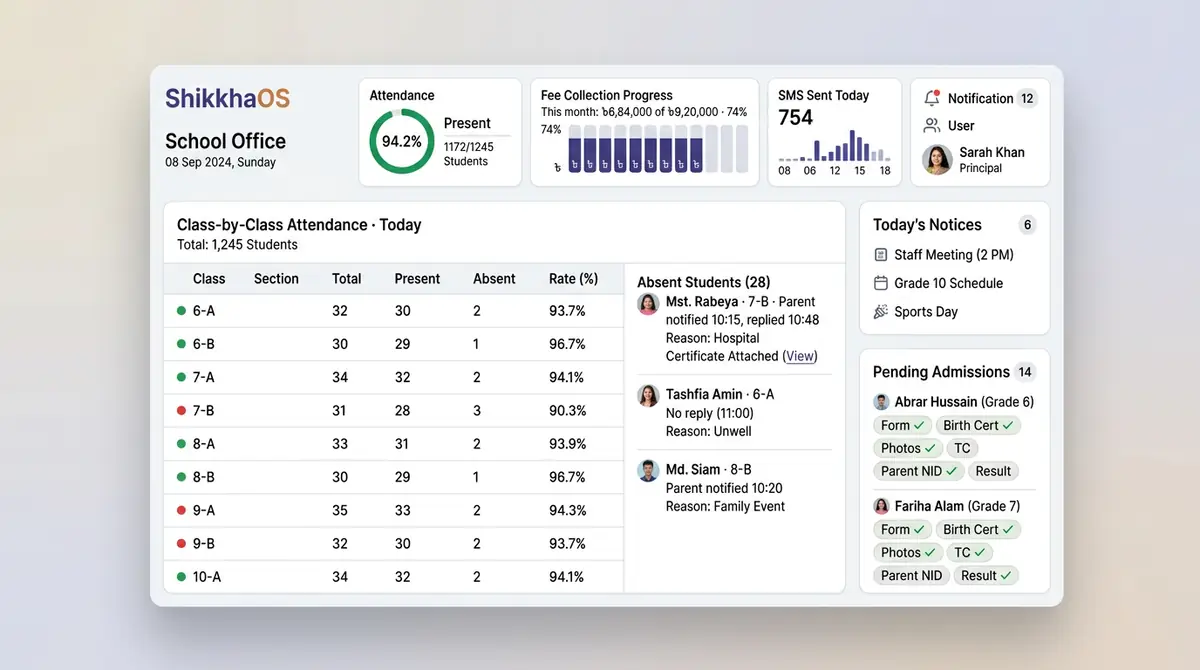
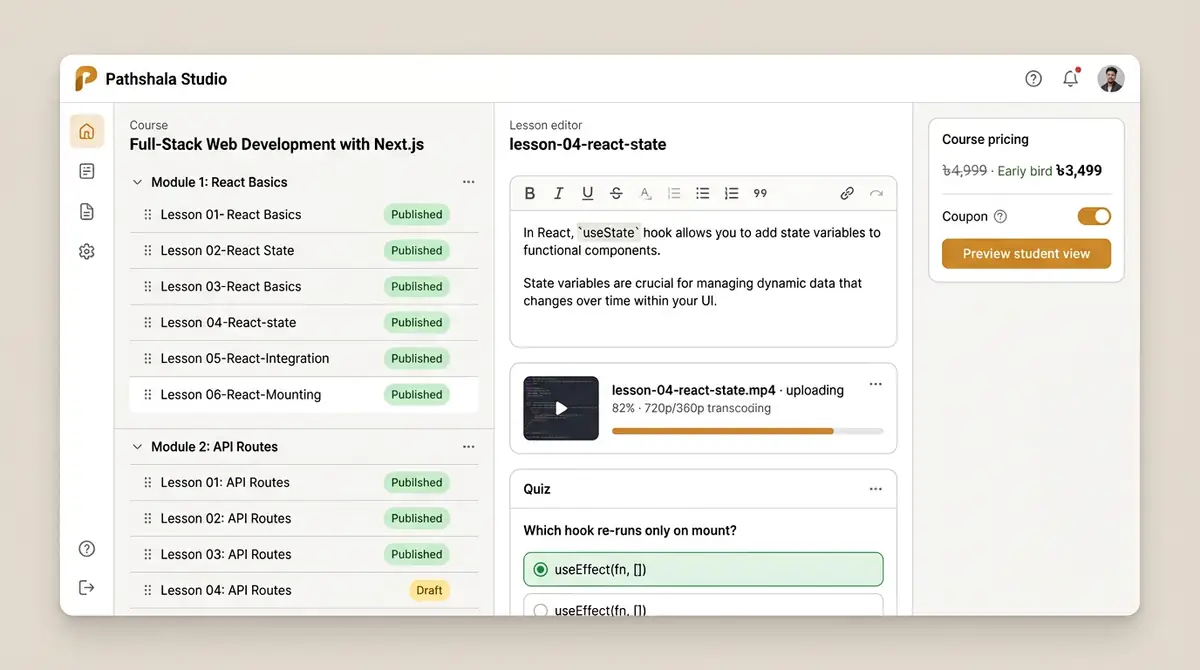
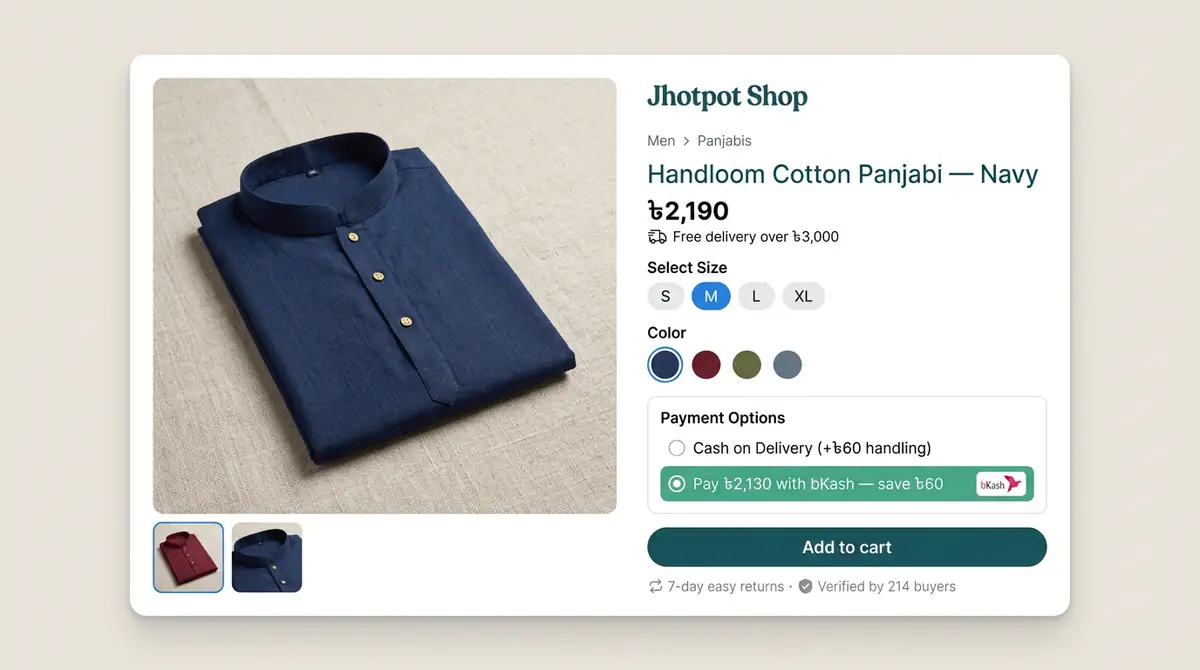
The product itself, on every device
studio renders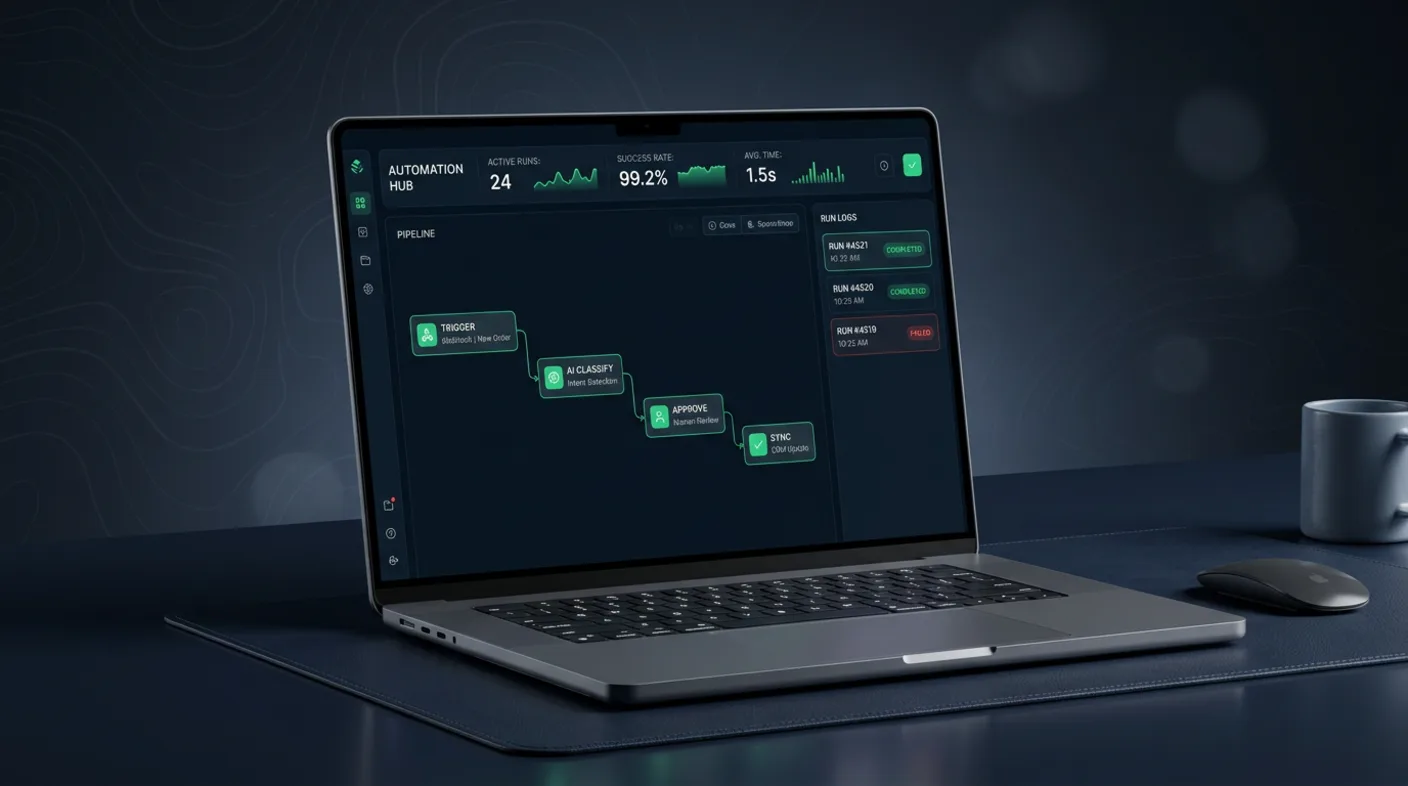
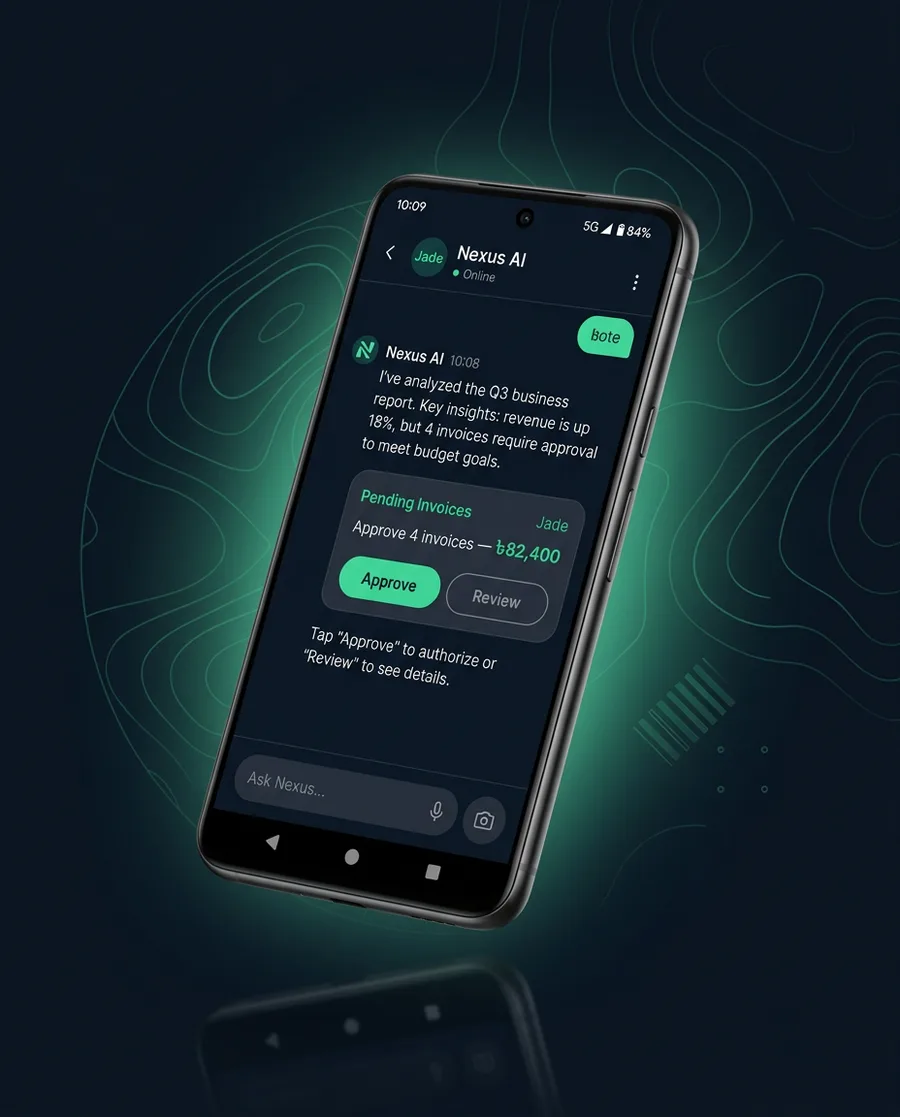
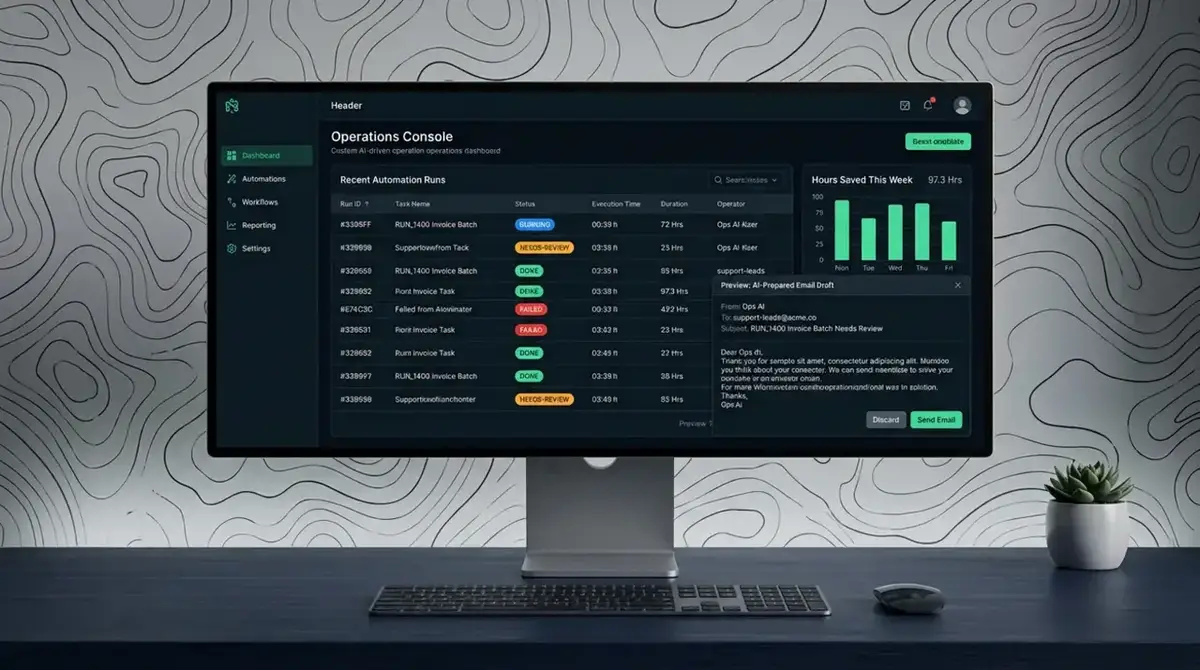
Frames of the live product rendered in the studio pipeline — the site itself is the demo: open anything, it is this codebase running.
The build
The pattern every small business drowns in is the same: requests arrive on three channels, information lives in five places, and someone copies between them all day. The Copilot is our answer built to production standards — a conversational front door, a retrieval layer over the business's actual documents, typed automations for the repetitive middle, and an approval queue where humans stay the authority. It runs this studio's own inbox triage; the client deployment is a configuration of the same engine, not a rewrite.
What we handled
- Chat-first operations: WhatsApp/web inbox triage with AI drafting and human send-off
- Document memory (RAG) over SOPs, price lists and policies — citations included
- Typed flow builder: triggers, classification, drafting, sync — every edge logged
- Approval queue as the product's spine: act-with-permission, never autonomous spend
- Owner console: run states, failure replay, hours-saved accounting
- Deployed on the client's stack and keys — no hostage data, no hostage accounts
The first flagship blueprint: a production-grade AI workspace this studio built for its own operations — chat-driven triage, retrieval over real documents, typed automations with human approval gates — offered to clients as a deployable product, not a slide. Everything below is honest about what it is: our machine, running our inbox, available to run yours.
We built the boring machine first
Small businesses don't lose hours to strategy; they lose them to copying: an enquiry lands on WhatsApp, its details go into a sheet, an invoice goes out, a payment gets chased, a question gets answered by re-reading the same PDF. Every “AI transformation” pitch ignores that the money leak is administrative. So the Copilot was scoped from one principle: an AI that removes a copy-paste step and then stops.
It runs here first — triaging studio enquiries, drafting replies against our own service docs, prepping invoice summaries — which is the only credibility test we accept for an automation product: it has to survive the week its author actually works through it.
What the Copilot actually is
Three surfaces, one engine. A conversational front door on the channels the business already lives in — WhatsApp and web chat — where the AI reads the thread, classifies intent, and drafts the next action. A typed flow canvas where automations are assembled from real primitives (trigger → classify → retrieve → draft → approve → sync), each edge validated and logged. And an owner console that shows every run in every state — done, needs-review, failed — with replay, so the business person, not the engineer, audits the robot.
Mobile is a first-class citizen because approvals happen on phones: a card arrives in the chat — “Approve 4 invoices, ৳82,400 total” — with full context a tap away and one-tap decision on the surface. That interaction, not a chatbot, is the product's centre of gravity.
Document memory with citations, not vibes
The retrieval layer indexes the business's actual truth — SOPs, price lists, policies, past tickets — and answers only from it, with sources attached so a wrong answer is a traceable sentence, not a mystery. Freshness is explicit: re-indexing is a flow like any other, and anything the docs can't answer routes to a human instead of being improvised. Model providers are interchangeable (OpenAI, Gemini) behind one adapter; keys, retention and region are set per client, never baked in.
Auto-fill, never auto-send
The hard rule from the client projects we took over: automation loses trust exactly once — the day it does something bold and wrong with no undo. So every side-effecting step (sending, paying, deleting, promising) sits behind a human gate by default, and “fully autonomous” is something a client can unlock per-flow with a written blast radius, not a checkbox. Failure states are product surfaces: retry buttons, diffs on what changed, and a run timeline that answers “what did it do at 3pm” in one click.
Hours-saved accounting is computed from actual runs — drafts accepted, threads closed, invoices matched — and shown in the console. If a flow isn't saving measurable time in its first month, the honest response on our side is to retire it, which is what we did with two of our own.
What deploying it for you looks like
Discovery (1–2 weeks): map the two flows with the most copy-paste cost, agree the metrics, sign the scope. Build (4–6 weeks): connectors to your actual systems, the flow canvas populated, RAG indexed over your documents, approval loops tuned with your staff. Pilot (2 weeks, then ongoing): your team drives it; we watch run-logs with you, cut what doesn't earn, and hand over the console, source and keys on day one — the deployment is on your cloud with your accounts, because a tool that can be turned off by a vendor is not a tool.
The whole thing is one stack story: Flutter mobile where humans approve, Next.js console where the business supervises, a typed Node/Postgres core around the model adapters. Which is exactly the set of languages this studio ships in production — see the technology pages for each link in that chain.
Public record
- Blueprint status
- In-house flagship — internal operations run on it; not yet a client case study
- Stack
- Next.js console · Flutter mobile · Node API · OpenAI/Gemini · RAG · Postgres
- Deploy shape
- Client's stack, their keys, their data residency — 6–10 weeks to first live flow
- Guardrail
- Auto-fill, never auto-send: every side-effecting step has a human gate
Under the hood — what each box took to build
Craft, per feature
Channel front door
WhatsApp + web chat unified into one triaged queue; intent classification drafts the reply, a human taps send — latency budget: under a second to a first draft.
Typed flow canvas
Automations as validated graphs — every edge carries a type, every run is replayable; untyped “AI workflows” are how vendors hide fragile glue code.
RAG over real docs
Chunk, embed, retrieve with citations; answers cite the SOP line or refuse to the human queue. Re-indexing is a flow, so freshness is schedulable.
Approval cards on mobile
Flutter surfaces with context-on-tap — decisions made in a queue line, not an office chair; every approval signs the exact diff it saw.
Owner console & replay
Run states, failure diffs, retry controls and hours-saved math from accepted outcomes — supervision is the interface, not an afterthought log.
Yours to operate
Deployed on the client's cloud with their keys and data residency; the studio's access is a privilege, not a dependency. Exit docs ship with the repo.
Commissioning this shape of product
The plan, as we would propose it
01 · Flow audit & scope1–2 weeks
Pick the two flows with the biggest copy-paste cost, define hours-saved metrics, written fixed price for the rest.
02 · Engine & connectors3–4 weeks
Channel front door, flow canvas wired to your real systems, RAG over your documents with citations live.
03 · Approvals & console2 weeks
Mobile approval cards, run-state console, failure replay, hours-saved accounting — the trust layer ships here.
04 · Pilot & handover1–2 weeks
Your team runs it against production load; we tune from shared run-log reviews, then hand over keys, repo and docs.
What a client actually wins
Days back per month, counted
Hours-saved is computed from accepted outcomes and visible in the console — the ROI argument stops being a deck and becomes a filterable table.
Humans stay the authority
Approval gates by default mean staff adopt the tool as relief, not threat — the difference between a pilot that spreads and one that gets quietly ignored.
Answers match your paper
Customer replies cite your own SOPs and price lists; a policy change re-indexes like any other flow, so the bot can't outdate your binder.
No vendor hostage line
Your cloud, your keys, documented handover — the studio that built it is your operator by choice each month, not by dependency.
What is not true (yet)
- Blueprint truth: it runs our operations and our demos — the first client engagements are priced to shape it, and this page says so instead of inventing customer logos.
- Integrations are connectors we build per stack (Sheets, Tally, WhatsApp Business API, common BD payment rails); “it integrates with everything” is a lie with a roadmap attached.
- Model costs are real and yours: typical BD-scale triage loads run pennies per ticket, but a busy month is a line item, sized in discovery.
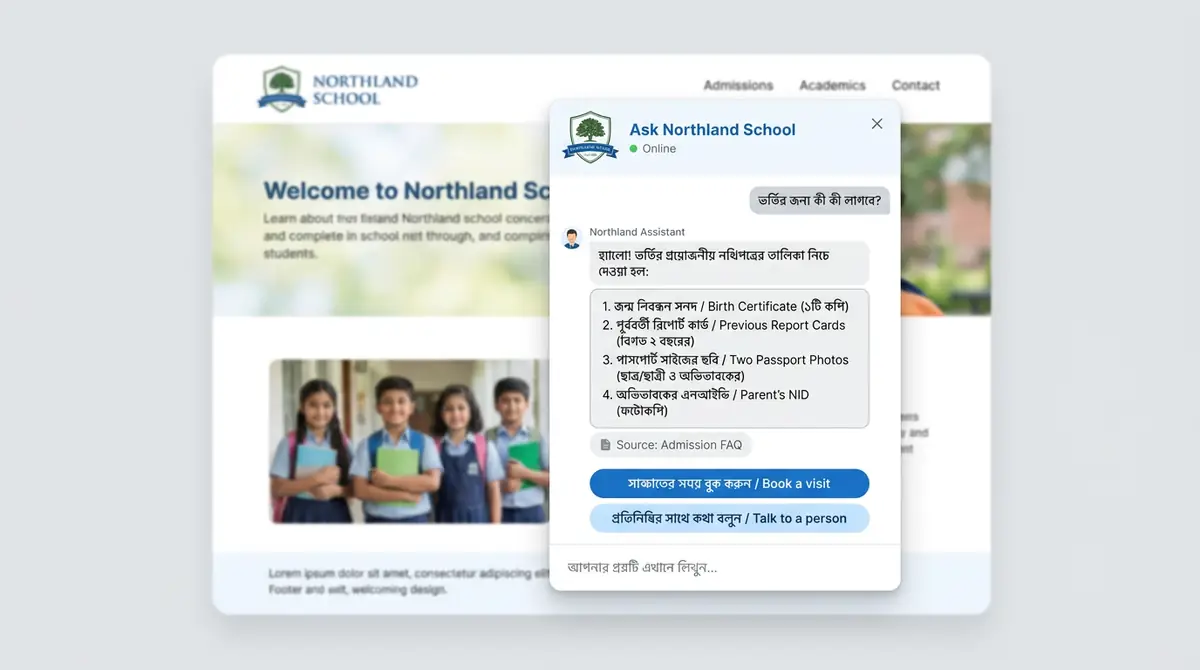
- Bangla and Banglish handle well in classification and drafts; tone review by a native-speaking team member stays in the loop for external sends until a client's corpus proves otherwise.
Testimonial slot — reserved, not invented
The listing has no review wall to quote yet — so there is no quote here. Real, credited words move into this card as players leave them.
Sponsored placement — reserved, disclosure first
Placements & partners
This is where a genuinely used tool or partner link would live — hosting, device labs, our travel products. It ships empty and labelled on purpose: when a sponsored link arrives, it arrives wearing this disclosure, never dressed up as editorial.
Answers where they belong
Questions this project answers
Want AI Automation Copilot-class engineering for your idea?
One brief in, the composer arrives with your platforms pre-ticked — Android, iOS, web, admin.
Is this a real product or a mockup?
Both readings would flatter it wrongly: it is a real internal system — this studio's inbox triage runs through it — offered as a deployable blueprint before any client claims are attached. The gallery is studio render of the working UI; the console is what we actually operate.
Will the AI send things without permission?
No — the default posture is auto-fill, never auto-send. Every side-effecting action carries a human approval card; per-flow autonomy is a decision you unlock with a written blast radius, never a default.
How is this different from hiring a chatbot agency?
A chatbot answers. The Copilot answers from your documents with citations, moves data between your systems through typed flows, and shows every run in a console your manager can audit. If a vendor ships the first part alone, price them accordingly.
What does deploying cost and take?
The shape is 6–8 weeks to live flows with handover, Discovery Sprint first at a fixed price — after which you get one number, not a range (that is the studio rule).
Where do our documents go?
Into your own retrieval store, on your cloud. Model providers run under no-training settings with per-client retention; the exact flows, keys and region are in the contract, and the console shows the audit trail forever after.
Does it understand Bangla?
Bangla and Banglish classify and draft well today; we keep a human tone gate on outbound sends early in a deployment, and tune from your actual corpus as it grows.
Begin the ascent
Everything on this page is checkable.
Store listing, code craft, and the way we scope — click through and verify, then send us the brief.