
Parbon — Delivery & Logistics Platform
Courier operations software built around the two places money actually leaks: the manifest a rider carries and the cash that comes back from it. Consignment states with evidence, run timelines that show delay as it forms, attempts-per-delivery metrics that end the same-customer folklore, and evening settlement where difference-zero is a gate, not a hope. Flagship blueprint: hardened on this studio's own parcel traffic between offices — deployable for district couriers and in-house fleets in 6–10 weeks.
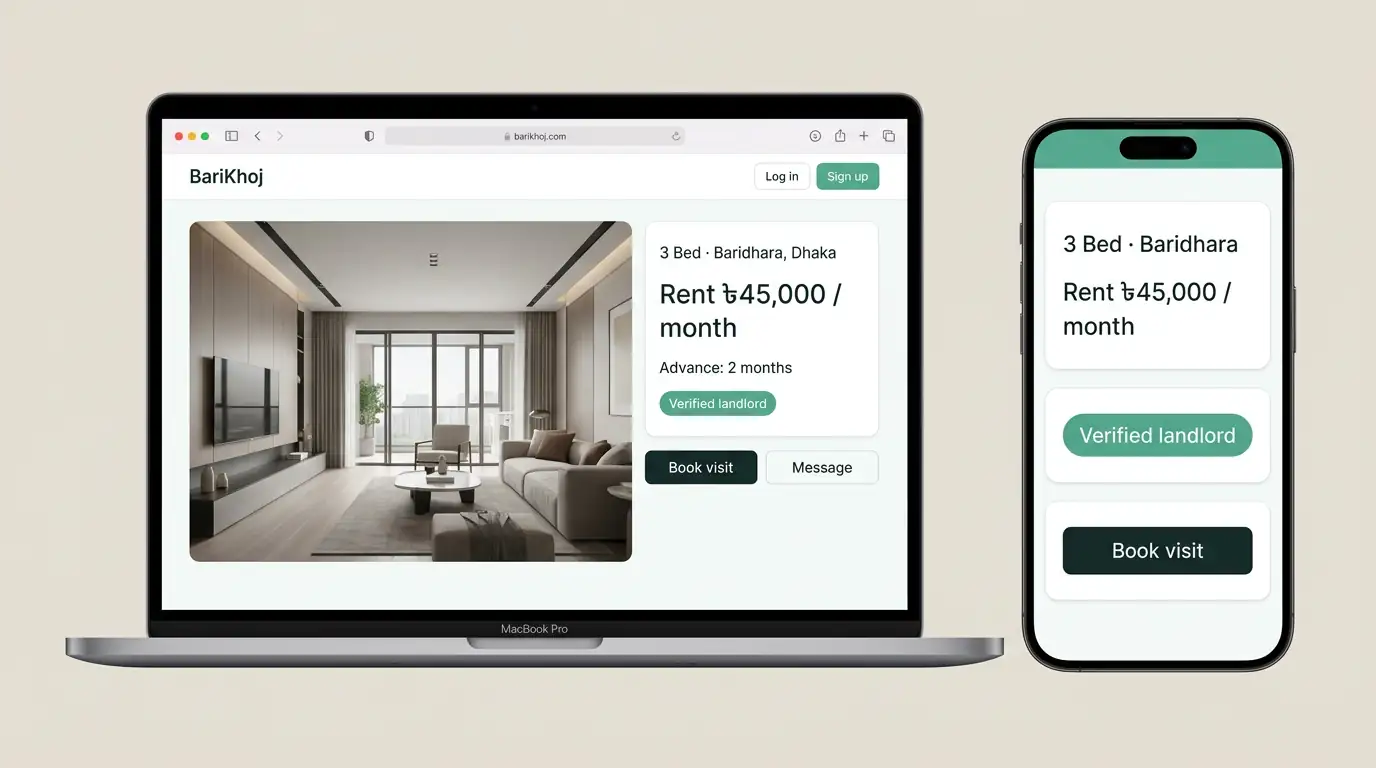
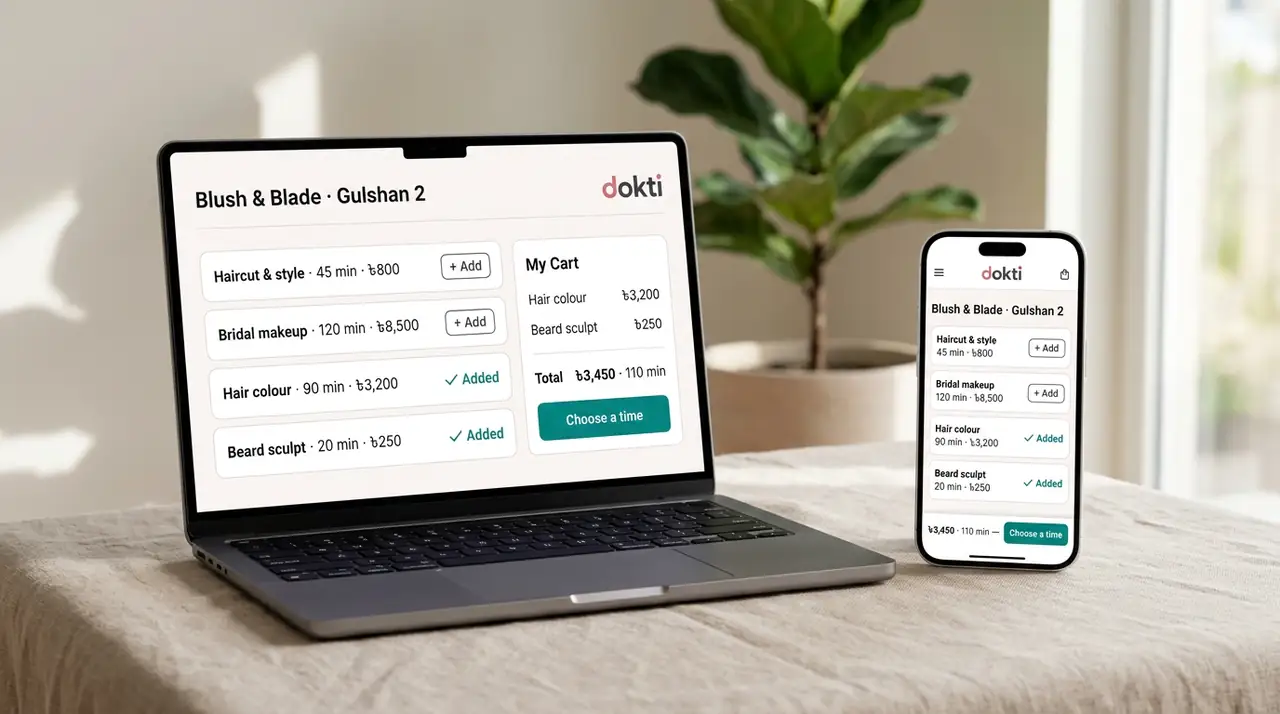
The product itself, on every device
studio renders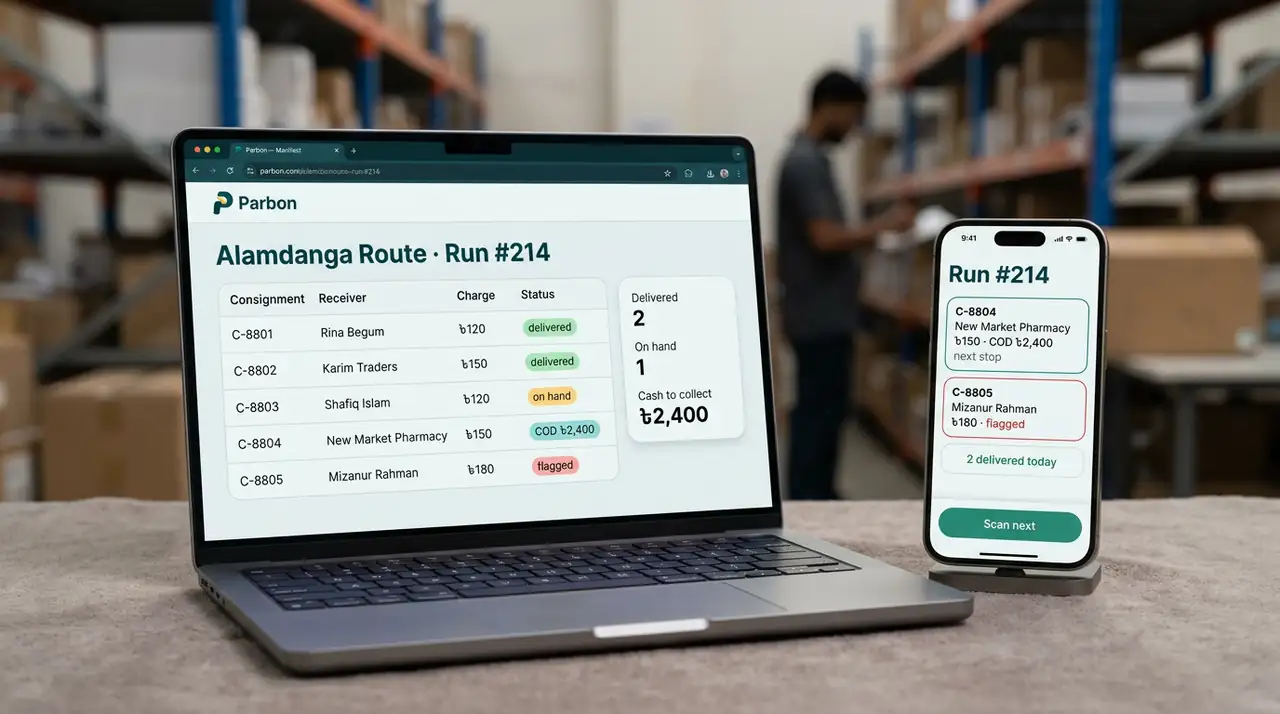
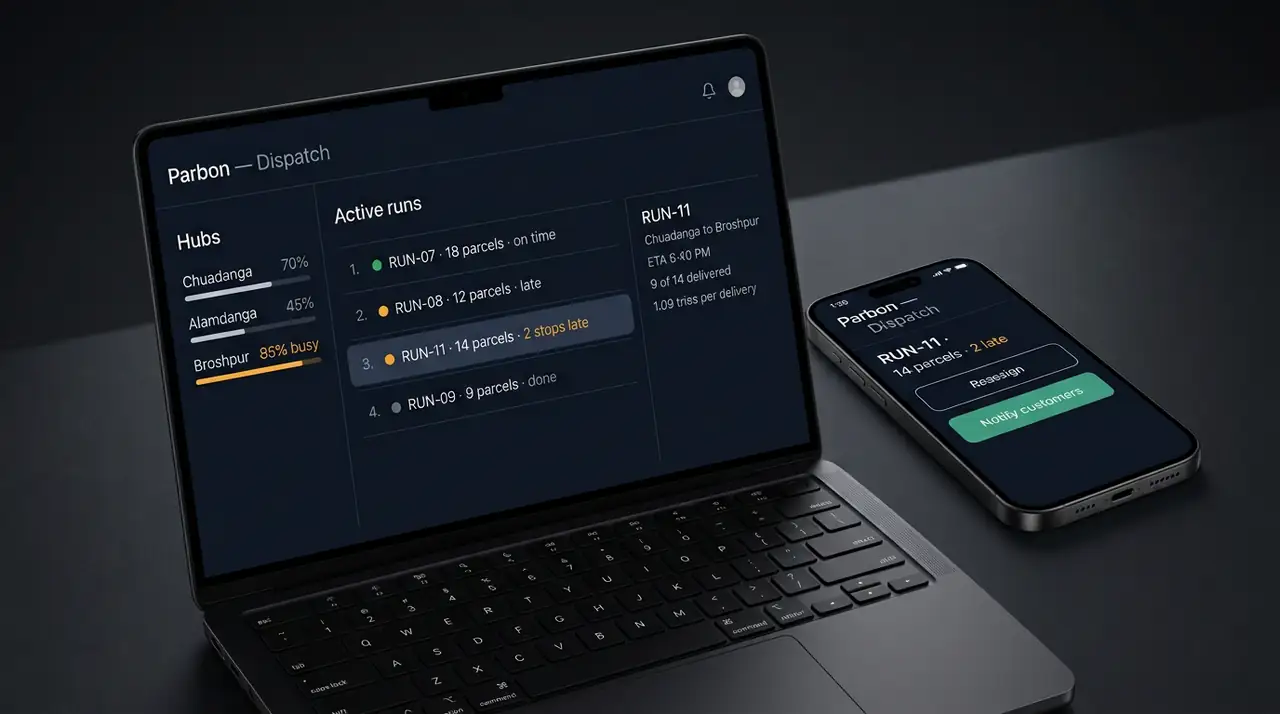
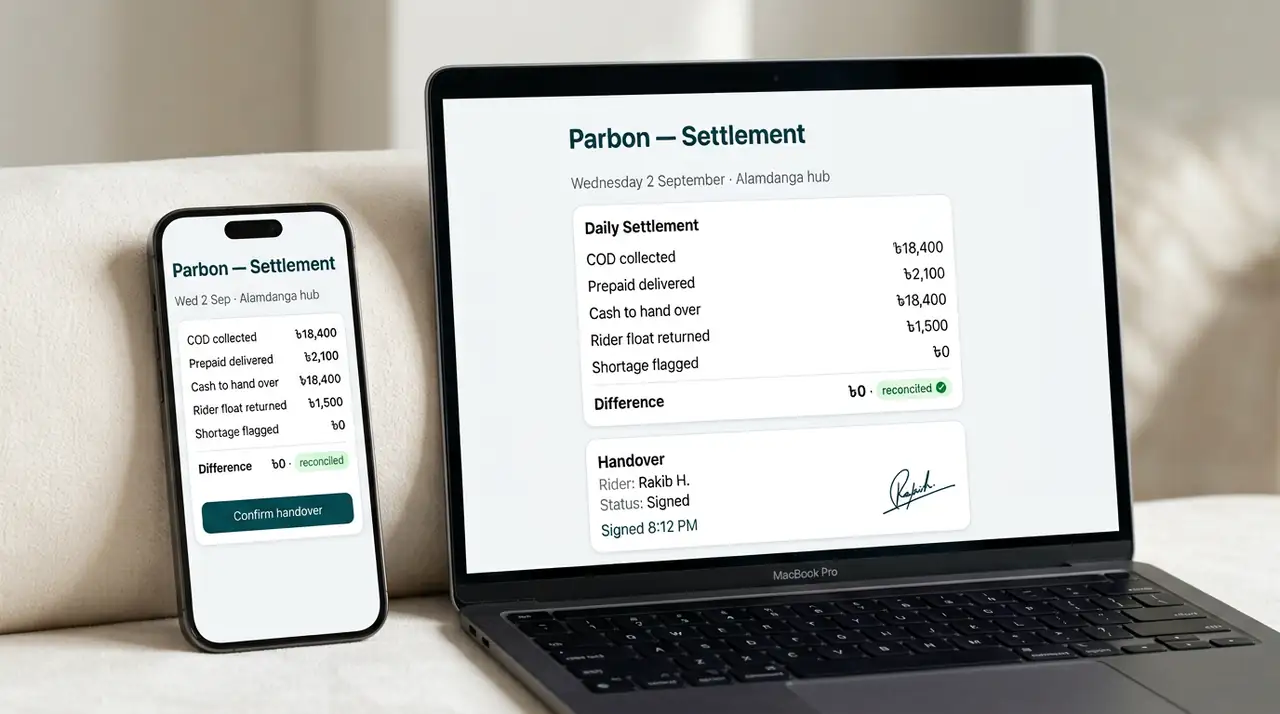
Frames of the live product rendered in the studio pipeline — the site itself is the demo: open anything, it is this codebase running.
The build
A district courier's real systems are a booking Facebook page, a paper manifest at the counter, and a cash box whose evening count takes two hours and one argument. Parbon replaces all three with one consignment state machine: every parcel is booked with proof, assigned to a named run, scanned at handover, delivered with a photo or a signature or a recorded failure reason — and the money (COD per stop, float per rider, revenue per zone) reconciles itself into a difference-zero sheet before anyone goes home. It runs this studio's own inter-office parcels today; the fleet deployment is configuration of the same machine, sized in weeks, owned by the courier, and deliberately boring at 8 PM — which is the highest praise a cash-reconciliation system can earn.
What we handled
- Consignment states with evidence: delivery means a photo, a signature or an entry — folklore cannot reach delivered
- Run timelines and attempts-per-delivery: delay becomes visible at 3 PM, not at Eid post-mortem
- COD as first-class data: per-stop cash, float accountability, and settlement that prints the argument away
- Rider phone is the product: manifest, scan, collect, report — no app store, no new hardware, works on what they own
- Transfer manifests between hubs: a parcel crossing districts carries its history, not a re-entry tax
- Failed-delivery rules the business owns: N tries then return, restocking, rest-day windows, all as policy not improvisation
The tenth flagship blueprint comes from the least glamorous queue in the country: the counter of a district courier at 5 PM, where parcels are handed over against paper and the day's cash is counted twice because nobody trusts the first count. Parbon is that counter rebuilt as software — a consignment state machine with evidence, COD as first-class data, a rider's phone as the whole interface, and an evening settlement sheet that ends the argument by design. It runs this studio's own inter-office parcels; the fleet deployment is configuration of the same boring, dependable machine.
Two places money leaks, and software never looked
Courier operations talk about route optimisation because that is what conferences reward. The actual losses are dumber and closer: a parcel marked delivered that sat in a bag for two days because the counter boy wrote “D/” on a manifest and moved on; and ৳18,400 of COD cash coming back as ৳17,900 with three riders each certain it was not them. Neither is an intelligence problem. Both are the absence of a record that changes when reality happens.
Parbon starts there. Every consignment is a state machine — booked, assigned, on hand, delivered, failed, returned — and each transition requires evidence: a scan, a photo, a signature, a failure reason from a list. The evening settlement is not a report, it is a gate: difference zero or the hub's day does not close. Conferences will not quote this software; owners will renew it.
The consignment is the contract
Booking captures the truth the delivery will be judged against: contents class, declared value, COD amount, the exact address plus the phone number that answers. Assignment to a run with a named rider transfers custody, and custody transfers are scanned at both ends — the manifest is not a wish list, it is chain of evidence. Attempts-per-delivery is computed from real tries, because that number is where “the customer never picked up” either becomes provable or stops being said.
Delivery closes with a proof object, not a tick: photo at the door, signature on screen, or the failure code with time and place. A returned parcel carries that history back to the sender in the same record, so “we tried” is a data field and the restock decision is a policy, not a phone call. The whole lifecycle is one row that never leaves the system, which is how a claim gets answered in ninety seconds instead of ninety days.
The rider's phone is the product
Everything the courier business actually executes happens on a phone: the run's manifest as a simple list in stop order, scan, collect cash, photograph the door, tap “recipient absent” and be on the bike in forty seconds. It is a web app by conviction — installable, offline-tolerant for the areas where the network sulks — because a delivery fleet is not going to provision new hardware, and an app-store dependency for a tool that runs a day's cash would be absurd.
The rider sees only what their next ten minutes need. That is a design rule, not a simplification: the dispatch board carries the hub's whole view — run lists, delay states, transfer manifests between hubs — while the phone stays a short list with honest buttons. Two surfaces, one state machine, zero re-entry, which is the exact arithmetic by which paper couriers lose an hour and a half every night.
Cash is a state, too
Every stop has its COD amount; every rider starts a float and ends it; every hub day closes on a settlement sheet where collected, delivered, returned and hand-over must reconcile to a difference of zero. Where they do not, the sheet says which stop, which rider and which timestamp — because “shortage” in the paper world was never mystery, just missing rows. Handover gets a signature and a time and it is done: 8:12 PM, signed, difference zero, lights off.
Zone pricing and weight slabs are policies the owner edits, not a requote each season; COD-plus-charges appears on the consignment before pickup, which is how the “but nobody told me ৳60” argument ends in the manifest instead of the counter. Money states, parcel states, one machine — the ledger and the tracker are the same truth from different chairs.
District-sized, chain-capable, boringly yours
Deployment is one hub for six to ten weeks: hub rules, rider training inside the live system during a real day, and two weeks where paper runs in parallel because the counter staff deserve an off-ramp while the new truth gets proven. Multi-hub adds transfer manifests — parcels crossing districts carry their history, no re-entry tax — and the owner dashboard starts answering the question district couriers have never been able to: what does each zone actually earn after rider cost and returns.
As always here: your data, documented schema, exports demonstrated during handover, one flat licence — no per-parcel toll on your volume, because software that taxes throughput stops being aligned with the business it claims to serve.
Public record
- Blueprint status
- In-house flagship — runs inter-office parcel traffic for this studio's own operations; district-courier pilots are the offer, not a past case
- Model
- Consignment state machine: booked → assigned → on hand → delivered/failed/returned, every transition with evidence
- Money
- COD per stop, rider float, daily hub settlement with difference-zero gate and signed handover
- Deploy shape
- Single hub in 6–10 weeks, multi-hub adds transfer manifests; riders need nothing but a phone browser
Under the hood — what each box took to build
Craft, per feature
Evidenced state machine
Booked → assigned → on hand → delivered/failed/returned, each transition needing a scan, photo, signature or reason code — the delivered state becomes a fact with a witness, not a tick on paper.
Attempts & delay metrics that end folklore
tries-per-delivery, on-time and failure reasons computed from real transitions, so the same three customer stories become a chart the owner can act on at 3 PM instead of a post-mortem after Eid.
Difference-zero settlement gate
COD per stop, rider floats, hub handover and the closing sheet that reconciles to zero or names the row that does not — with signature and timestamp, because cash trust is arithmetic plus accountability.
Offline-tolerant rider web app
Installable phone surface with queued scans and photo capture for weak areas, stop-order manifest, collect and report in forty seconds — fleet-wide on the handsets riders already own, no stores, no new hardware.
Transfer manifests between hubs
Parcels crossing districts change custody with a scanned handover while keeping one continuous record — which is how the hub network stops being a fax machine between branches.
Owner policies, not vendor rules
Zone tariffs, weight slabs, return windows, rest-day and try-count limits live in the operator's own settings; the software enforces what the business decides and never quietly edits it for you.
Commissioning this shape of product
The plan, as we would propose it
Counter weekWk 1
Two days at the hub and one run behind a rider: where the paper lies, where the cash hides, what a “delivered” means when the belt is loud. The hub's own shortage history becomes the pilot's success bar.
One hub liveWk 2–5
Consignment states, booking rules, COD and settlement wired to the real day; paper manifests kept in parallel for two weeks so the counter can compare truths, and the first difference-zero evening becomes the sales deck.
Rider & phone hardeningWk 4–7
Offline scans, photo evidence, failure reasons under real rain and real signal gaps; training inside the live tool, on a shift, with the dispatcher watching the delay board tighten.
Network & handoverWk 7–10
Transfer manifests for the second hub, owner dashboard on zone economics, exports demonstrated with the accountant, and the settings opened fully to staff — every rule editable by the business from then on.
What a client actually wins
Delivered stops meaning “probably”
Evidence-gated transitions cut the parcel-that-sat-for-two-days class of loss outright, and the same field answers customer claims in minutes because the record already holds the photo, the time and the name.
The cash box closes at 8:12, not 10:30
Difference-zero as a gate turns nightly reconciliation from a two-hour negotiation into a signature; and a shortage that names its row at 9 PM costs nothing next to the one discovered during Eid stocktake.
Zone economics become visible
Attempts, failure reasons and per-zone margin turn the owner's oldest gut feeling — “Broshpur is expensive” — into a number, a cause and a policy, which is how fleets stop pricing by folklore.
Capacity without headcount
A hub that runs on one state machine absorbs its growth inside existing staff; the paper courier's ceiling was never the bikes, it was the two clerks whose whole day was re-entry.
What is not true (yet)
- Blueprint truth, plainly: Parbon runs this studio's own parcel traffic, which is real volume but not your fleet's reality — the district-courier pilot is priced and scoped like the pioneer it is, and no operator logos exist to quote yet.
- It is for couriers, not for marketplace armies: no dynamic gig-pricing auction, no rider supply exchange, no “30-minute delivery” marketing math — a fleet with its own riders and its own manifest discipline is the exact shape this fits.
- Physical loss is not a software state: a parcel damaged in a van leaves evidence but not an inventory — claims, insurance and repair economics stay the owner's ledger; Parbon records truth, it does not indemnify.
- The phone is only as good as the network around it: offline tolerance means queued writes and degraded scans rather than stopped delivery, and a hub that wants guaranteed real-time tracking under poor signal needs hardware decisions we will name in the audit and not in a promise.
Testimonial slot — reserved, not invented
The listing has no review wall to quote yet — so there is no quote here. Real, credited words move into this card as players leave them.
Sponsored placement — reserved, disclosure first
Placements & partners
This is where a genuinely used tool or partner link would live — hosting, device labs, our travel products. It ships empty and labelled on purpose: when a sponsored link arrives, it arrives wearing this disclosure, never dressed up as editorial.
Answers where they belong
Questions this project answers
Want Parbon-class engineering for your idea?
One brief in, the composer arrives with your platforms pre-ticked — Android, iOS, web, admin.
Is this for a courier company or a delivery app?
For the courier: the company that owns riders, hubs and the cash. An on-demand app is a different animal — supply auctions and instant pricing — and this product has no interest in pretending otherwise. If you run a fleet with manifests, it is yours.
Our riders have cheap phones and worse signal. Still?
The rider surface is an installable web app built offline-first: scans queue, photos compress, settlement stays on the hub device where the network behaves. Weak signal degrades the experience; it does not stop the day, which is the only promise worth making about a Bangladeshi road.
What stops a rider from tapping “delivered” at the gate?
Evidence gates: a delivery needs a scan, a photo or a signature to exist, and the settlement sheet ties their collected cash to their stops. A rider can still misbehave — the point is that they now must do it with falsifiable artefacts instead of blank paper.
Can we keep our WhatsApp customer updates?
The system generates the messages that matter — assigned, arrived, COD amount, failure reason — so the owner's WhatsApp becomes optional instead of load-bearing. Customers get fewer questions because the parcel's truth arrived before they asked.
Do you integrate with national postal or railway transfer?
Any transfer partner that can hand over against a scanned manifest list can enter as a hub in the network. No API? The CSV handover path exists and is used daily by teams with worse infrastructure than whatever the partner offers.
Why does settlement end the day instead of reporting it?
Because a reconciliation that merely informs becomes paperwork, and paperwork loses to a busy evening. As a gate, it changes behaviour — which is the difference between a system couriers use and a system couriers file.

Begin the ascent
Everything on this page is checkable.
Store listing, code craft, and the way we scope — click through and verify, then send us the brief.